
Supplier profile: Midea
At kbb Birmingham, Midea signalled its intent to shake up the UK kitchen market with innovation, connectivity, and a fresh approach following its acquisition of Teka.
For a visit to a major trade show like kbb Birmingham to be worthwhile, it needs the right mix of new and established brands. Familiar faces and first-time contacts are all part of the experience, but for appliance giant Midea – definitely a new name to many – it was something more than just an introduction.
It was a statement: one of the biggest global appliance manufacturers has arrived in the UK.
First, let’s get the name sorted – it’s pronounced “my dear” – and while that unfamiliarity is about to change rapidly, the other brand in its show portfolio was already well known to many kitchen specialists: Teka.
Midea acquired the 100-year-old Teka Group a year ago, and while its presence in the UK has been inconsistent over recent decades, it is a well-established company elsewhere. It operates in over 120 countries, employs 3,000 people, and holds significant market positions in countries such as Spain, Portugal, Turkey, and Germany.
Combine the technological, financial, and manufacturing clout of Midea with the European heritage of Teka, and it’s clear why the group is turning its attention to the UK kitchen specialist market.
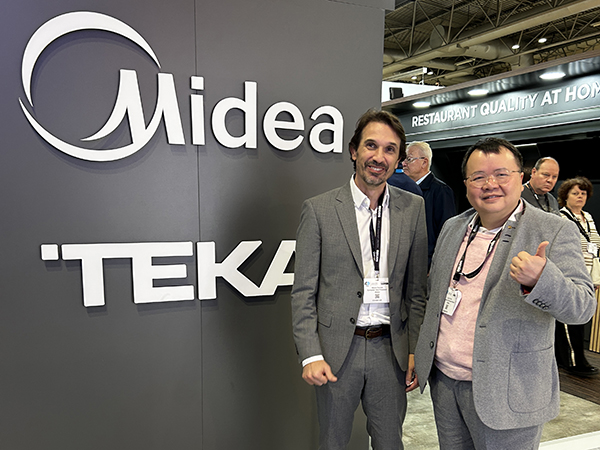
Speaking exclusively at the show, Midea Europe Region president Larry Yuen (pictured right) said he believes there is still room for companies that bring something genuinely different.
“The market is still very promising,” he said. “Of course, it is crowded and quite saturated in many areas, so you cannot just arrive and do the same thing as everybody else. You have to innovate and bring new ideas. That is the opportunity we see.”
Market position
The European market is dominated by large, established brands, but Yuen says differentiation is the key rather than taking them on directly.
“If you go head-to-head with the incumbents, you simply spend a lot of money trying to replicate what they already do well,” he explains.
“Our approach is to be different. We are the largest smart home appliance manufacturer in the world, and we invest heavily in connectivity, automation, and AI. The challenge in Europe is helping consumers understand why these technologies are useful and how they make life easier.
“We also manufacture many of our own core components – motors, compressors, and other technologies – and that level of integration gives us flexibility and competitiveness that many companies do not have.”
The Teka Group is a business with deep European roots, so its value to Midea across the continent is clear. But in the UK, its history has been, by its own admission, more patchy.
“Teka has been present in the UK before, sometimes directly and sometimes through distributors,” says CEO Mauro Correia (pictured left). “But we had difficult moments, particularly during Covid and the inflation that followed.
“But when we speak to people in the trade, the perception of Teka in terms of design and quality is still strong. What is different now is that we have the strength of Midea behind us, giving us technology, scale, and competitiveness.”
However, he insists the brand’s identity remains intact. “Midea has been very respectful of the heritage,” he says.
“Teka is keeping its European design approach and its focus on the kitchen environment. We talk about the experience of cooking and the emotional side of the kitchen, rather than only technical performance.”
From a Midea group perspective, the UK has been chosen deliberately as a priority market for growth. “Strategically, we identified the UK and Italy as important markets,” Yuen says. “But timing matters. We wanted to make sure we had the right organisation, products, and service structure before we entered. Now we feel ready.”
“We are not going to work with everyone,” Yuen added. “It has to be a two-way decision. Retailers choose us, and we choose them. We want partners who believe in the brand and want to grow with us. It is about total margin – balancing volume and profitability – so retailers can build a sustainable business.”
Correia sees opportunity in a shifting and rapidly changing market. “Some traditional suppliers have had very tough moments in recent years,” he says. “That then creates space for companies that can bring both innovation and competitiveness at the same time.”
Given the scale and ambition of Midea in Europe, and the UK specifically, few would bet against this translating into meaningful UK market share.
With a resurgent Teka, the offer could be comprehensive enough to make many kitchen specialists take notice.