
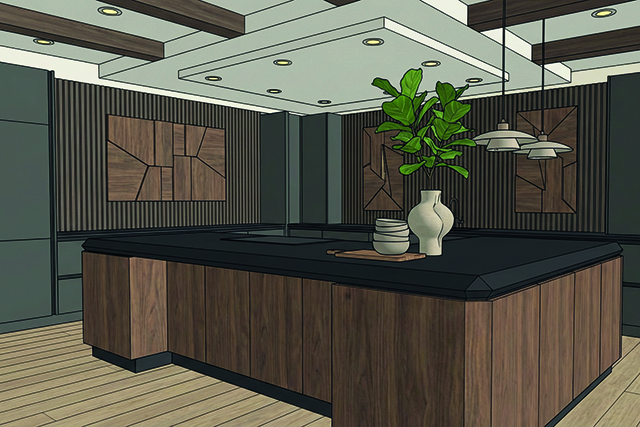
Opinion: People buy what they can see
After a decade in the KBB industry, Clara Hend from KBB Render argues that stronger visual storytelling is the missing link between a good design and a signed contract.
Words: Clara Hend
For as long as I can remember in my career, selling a design has never only been about measurements, materials, or technical drawings. It is about helping a client see the space before it exists.
That lesson has become clearer to me more than ever. The better the visuals you present to a client, the more likely the project is to sell.
I’ve worked closely with homeowners to bring their spaces to life and have proven success as a salesperson. I used to believe that success came primarily from product knowledge, communication skills, and understanding client needs.
While those elements certainly matter, over time I began to notice another factor consistently influencing whether a project moved forward.

Visualisation
Clients are often making one of the largest investments in their home. Yet many are being asked to make those decisions while looking at flat plans, mood boards, or basic computer-generated images.
For someone who does not work with design software every day, interpreting these visuals can be difficult.
Early in my career I developed an interest in 3D modelling and visualisation. Naturally, my renders became a central part of my design presentations. I began framing spaces more intentionally and thinking about how a client would emotionally connect with the room they were looking at.
Instead of simply presenting a design, I was presenting a vision of their future home. There was a clear correlation between the quality of those visuals and my sales conversion. When a client could see a space rendered in a way that felt believable and immersive, the conversation changed. They were no longer trying to imagine the outcome; they were reacting to something that felt real.
However, working within the KBB sector also exposed a limitation. Most industry design software is built primarily for planning and specification rather than photorealistic visualisation. While they are powerful tools for layouts and technical details, achieving truly convincing imagery often requires exporting models and going through a far more complex and time-consuming 3D rendering pipeline.
For many designers, that level of workflow simply isn’t practical within the pace of showroom sales. That challenge eventually led me to develop a different approach. I built a tool called KBB Render, designed to simplify the process of producing high-quality visuals directly from typical design outputs.
Today, I use it as part of my own workflow to quickly generate compelling imagery for clients without needing to step fully into traditional 3D production. It was a tool built for myself; however I have decided to make it available to anyone else in the industry.
But the bigger point goes beyond any one tool. As designers, our role is not just to design spaces, it is to communicate them. The clearer and more emotionally engaging that communication becomes, the easier it is for clients to make decisions.
In an industry where imagination determines whether a project moves forward, strong visual storytelling can be one of the most powerful tools a designer has.
The design might already be right. Sometimes, it simply needs to be seen properly.