
Bathroom Brands: From the click to the showroom
Bathroom Brands is investing heavily in digital tools designed to drive consumers to its independent customers. "We want to inspire, educate and guide people towards retailers," they say…
*Advertisement Feature
Bathroom Brands has been supporting and nurturing its independent retailer customers for over 20 years, and now a new initiative sees it investing heavily in technology with one clear objective – drive better-informed consumers to its retail network.
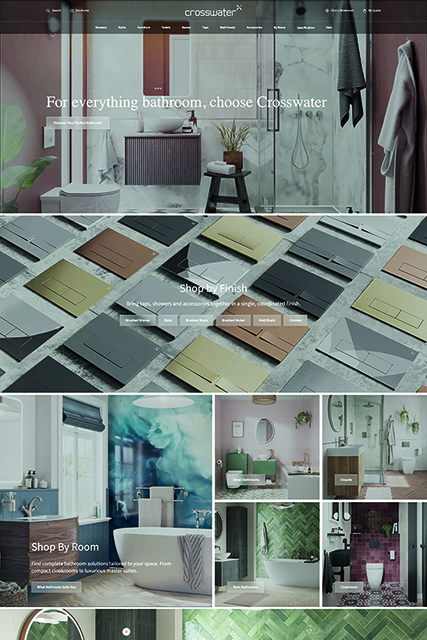
Rather than creating a direct e-commerce platform, the group has rebuilt its Crosswater website and supporting systems to make it easier for consumers to research products, gather inspiration and arrive in showrooms with a clearer idea of what they want. For retailers, that means warmer leads, more informed conversations and, ultimately, an easier path to conversion.
“It’s all with the aim of driving consumers to our retailers,” says marketing manager Natalie Riley. “We’re not trying to sell directly to the public, we’re trying to make it easier for our retailers to reach them.”
While this could be seen simply as a website relaunch, the reality is that it represents a broader investment in systems, data and future capability – underlining how seriously Bathroom Brands is taking it as a tool to support physical retail.
The previous Crosswater site had served the business well and had been refreshed over time, but it had reached a point where it needed a platform that could better support its growing catalogue and allow it to move faster without labour intensive manual input.
“Our old website needed every product entered manually,” says Riley. “But now we’ve moved all our products to a central database, and the new website links directly to that, so we can put out product information much faster and make sure the information is much more accurate because it comes directly from that main source.”
Jessica Howard, group brand and creative services manager, says the previous platform worked well for its purpose but it limited how quickly the business could evolve digitally.

“The old website had been refreshed a few times,” she says. “But the system behind it was older, so every time we wanted to make a change it required quite a lot of coding and care.”
The new site has been rebuilt from the ground up and gives the team more flexibility, improves internal efficiency and creates a platform that can evolve. It also removes much of the manual work behind product launches, with new items able to go live almost immediately.
That’s all the technical investment behind the scenes, but for consumers visiting the site, the biggest shift is in how Crosswater presents its products. as it is designed not just to display ranges, but to inspire and guide
decision-making.
A key feature is a “shop by room” approach, which allows users to browse by bathroom type – such as a main bathroom, en suite or cloakroom – rather than needing to understand specific product categories from the outset.
“We launched a lookbook last year aimed at consumers and we’ve essentially built that into digital form on the website,” says Howard. “If you’re coming for inspiration and you know the type of room you’re doing, it’s all there in one place, and then we can push you through to a retailer.”
Guiding consumers
That shift reflects a recognition that most consumers do not think in product terminology, but instead try to visualise what might work in their own space.
“It can be quite hard as an end user to understand the difference between types of enclosures, baths or fittings,” Howard says. “Whereas if you can see something that looks like your bathroom and you’re given a rough price, it becomes a far warmer lead for the retailer.”
The new site combines clear cut-out product images with lifestyle photography, helping users understand individual items while also seeing how they work together in a real setting.
Riley says her relative newness to the industry at the start of the process helped highlight how confusing some of the industry jargon can be.

“When we started, I looked at the classifications and thought, ‘I have no idea what this means,’” she says. “If I’m just looking for a tap for my basin, I don’t know where I’m meant to go.”
That prompted a rethink of both structure and presentation, including clearer navigation, imagery and line drawings to help users immediately understand what they are clicking on.
“Once you can see what something is, it makes much more sense,” she says.
The same thinking has been applied to search engine optimisation. Bathroom Brands has invested in understanding how consumers actually search online and building content around those terms. This also includes landing pages and buying guides that explain not just individual products, but the wider considerations involved in planning a bathroom.
“We call it ‘brassware’ as an industry, but no consumers actually search for that,” says Howard. “If we can capture the way they search and bring them into our website, we can then point them in the direction of one of our retailers.”
Supporting retailers
While the website is consumer-facing, its real value lies in how it supports retailers. For example one of the most important features is giving users the ability to build a list of products they are interested in and take that directly into a showroom.
So, instead of arriving with a vague idea, customers come in with product codes, finishes and a clearer sense of what they want. The inclusion of RRPs helps manage their expectations early, and gives consumers a realistic understanding of budget before they even step into the showroom.
That, in turn, creates a much more qualified lead for the showroom.
“It means the retailer has the benefit of only really offering good news,” Riley says. “If somebody goes in with more realistic expectations, the retailer can be much more positive and offer clarity.”
Howard adds that the intention is not to replace the retailer’s expertise, but to make the first conversation easier: “We’re not trying to do their design job for them,” she says. “We’re just helping the customer get to that point of knowing what they’re looking for more quickly.”
The benefits extend beyond lead generation. Because the website is connected directly to Bathroom Brands’ product systems, data can now be shared more consistently across platforms.
Riley points to tools such as TruBlue as an example. “Wherever they’re looking, it should now be consistent,” she says. “That reduces the need for manual updates and helps avoid discrepancies.”
The same approach is being applied to customer support. Bathroom Brands is expanding its FAQ and troubleshooting content to make it easier for both consumers and retailers to find answers quickly.
But, although the website is already live, both Riley and Howard see it as the start of an ongoing process rather than a finished product.
“There’s always going to be improvements,” says Riley. “You learn from how people use it and adapt.”
Future phases are expected to include deeper integration with other systems, potentially allowing consumers to see where specific products are on display and helping guide them to the most relevant retailer.
More broadly, the new platform creates a foundation that can evolve as the market changes and moves on.
For Howard, that long-term view is key. “The whole point is to support retailers in the most practical way possible,” she says.
So, yes, on the surface, Bathroom Brands has a new website. But looking a bit deeper, the actual story is about a big supplier recognising that, in a digital-first world, supporting independent retail means helping shape the customer journey before the showroom visit even begins.
If you get that right you can deliver customers who are more informed, more confident and more ready to buy.
Experience the all-new website for yourself at crosswater.co.uk
