
Johnson Tiles says it is considering co-opening a new pilot manufacturing facility in Stoke-on-Trent, just two years after the tile supplier stopped UK manufacturing entirely over rising costs.
The “pilot” or “demonstration” facility would be opened in partnership with materials technology company Dekiln, which has recently developed a new kind of tile composite product with a carbon footprint that is reportedly 94% lower than conventional ceramic tiles.
Said to contain more than 95% recycled content, Dekiln’s patented process combines plant-derived binders with waste mineral powders to create ceramic-like composite materials, designed as a kiln-free, low-energy alternative to traditional ceramic substrates.
Johnson Tiles says it has been supporting the commercial development of Dekiln’s new tile product, which is now moving towards full-scale manufacturing.
The partnership will allow Dekiln to accelerate its commercial route to market, with Johnson Tiles support the process with its manufacturing expertise and market knowledge.
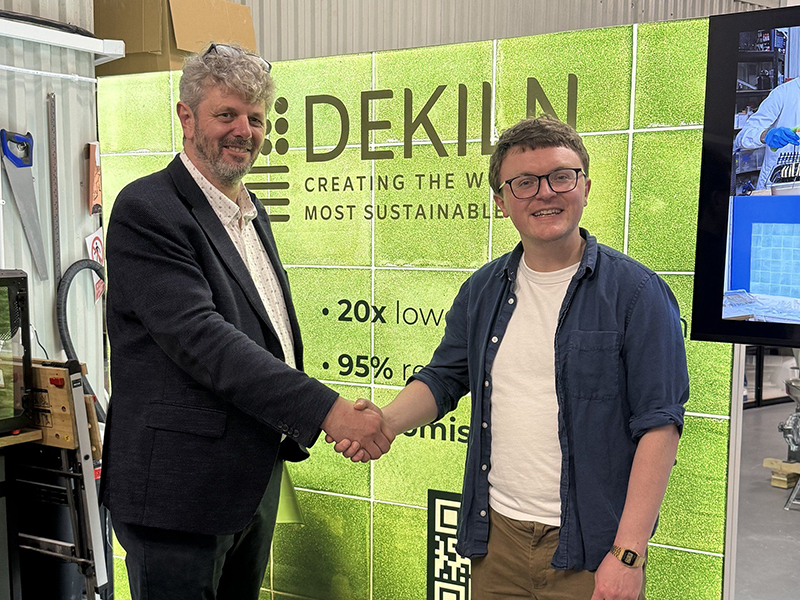
“This marks an important milestone for Dekiln as we transition from the laboratory to industrial scale manufacturing,” commented Dr. Aled Roberts, Dekiln’s CEO and founder. “Johnson Tiles’ technical expertise, market reach and sustainability focus makes them an ideal partner to support our ambition to scale-up and commercialise our technology.”
Jason Bridges, Johnson Tiles’ procurement director, added: “Johnson Tiles are really excited to be forming this partnership with Dekiln and look forward to adding our technical expertise and market knowledge to ensure this unique concept reaches its potential in the marketplace.
“Aled’s fresh thinking on solving the recycling of waste alongside removing the sintering process to create a product with all the performance and aesthetic qualities of traditional tiles without anywhere near the embodied carbon is a real game-changer and a concept that aligns perfectly with Johnson Tiles’ sustainable thinking.”
Johnson Tiles closed its previous manufacturing facility in Tunstall in 2024. At the time, the company announced it would pivot to an outsourced production model, describing it as “increasingly unsustainable” to manufacture tiles in the UK. This ended the company’s long-running tradition of manufacturing tiles in the UK, which first started in 1901.
Last year, the Tunstall site was acquired by retailer Tile Mountain, which already operated a 400,000 sq ft warehouse complex next door to the closed Johnson Tiles site.