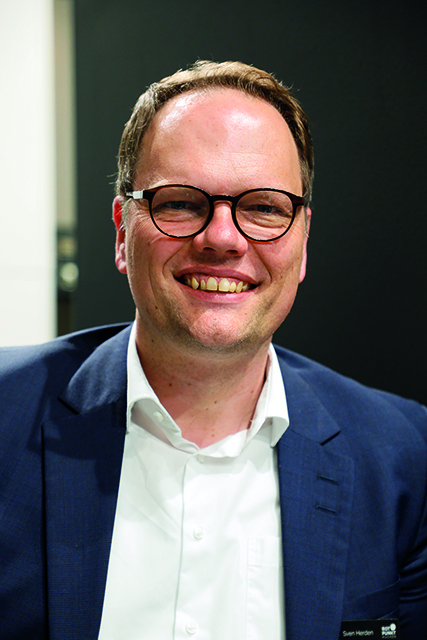
Resilience 2026: Sven Herden from Rotpunkt
What’s the secret to longevity in the KBB industry? According to Rotpunkt’s managing director of marketing and sales, Sven Herden, it all comes down to flexibility, stability and diversification.
Advertisement Feature
Listen to a full interview with Sven Herden on a special episode of The kbbreview Podcast. Listen NOW using the player below or go straight to this episode in Apple Podcasts, Spotify or YouTube. Alternatively, simply search ‘kbbreview’ wherever you get your podcasts.
We’re a 96-year-old family-owned business. In the past we described ourselves as a kitchen manufacturer, but we’re more than that. We go beyond the kitchen to create furniture for the whole home.
Everything we make is highly bespoke and customised, but it’s produced through industrial manufacturing. Last year we turned over around €100m, producing between 20,000 and 25,000 kitchens, and we do that with around 380 people working together across the business.
Many people say that the market remains challenging, but I think it’s important to separate the overall market from Rotpunkt’s own position. Globally, we’re surrounded by uncertainty.
Consumers are tired of hearing bad news – wars, inflation, economic pressures – and I think the overall kitchen market has become a smaller cake. Retailers are facing enormous challenges too. Customers are holding back spending, competition is intense and consumers believe they’re better informed than ever, particularly with AI now entering the conversation.
For us, though, we’re very grateful because we’re flying at the moment. I don’t say that with any arrogance because we know nothing is guaranteed, but we’ve worked very hard alongside our retail partners to reach this position. We’re operating in a niche where customers want kitchens that are as individual as the people who live with them.
That level of personalisation continues to be in demand, and fortunately that’s exactly where Rotpunkt sits.
Above all of that, Rotpunkt is a brand that has endured through countless disruptions over nearly a century, so our reslience is something that we’ve demonstrated time and time again.
First of all, we’re a very human-centric business. Throughout all those difficult periods we’ve always tried to keep our people. It has never been a hire-and-fire mentality here, so the knowledge has stayed inside the company.
Secondly, we’re extremely flexible. Larger organisations can sometimes take a long time to change direction, but we’re able to react quickly. We can adapt our policies, our products, our pricing or our strategy when we need to.
We’re also open-minded enough to admit when we’ve got something wrong. That’s not criticism, but instead it’s recognising that sometimes you’ve gone in the wrong direction and it’s time to change course. I think all of those things together have given us the resilience we’ve needed over the years.
Future formula
Before Covid we all relied on just-in-time manufacturing. During Covid we learned that wasn’t a formula for the future.
We’ve invested in much larger stocks of raw materials and components so that, in a worst-case scenario, we can continue supplying customers. We’ve also diversified our supplier base so we’re never dependent on a single source.
Inside the factory we’ve designed production so that if one assembly line experiences a problem, we can move production elsewhere without customers noticing anything other than, perhaps, a slightly longer lead time.
Technology is helping as well. Better forecasting – and increasingly artificial intelligence – will allow us to predict demand much more accurately. In future we’ll have a much better understanding of the materials and finishes we’ll need before the orders even arrive.
For our retail partners, this essentially means we can guarantee stability. When a retailer invests in showroom displays they need confidence that the manufacturer will still be there in years to come. At the same time, we’re not reducing choice to make manufacturing easier.
Many manufacturers simplify their ranges because variety costs money, but we’ve gone the other way. Our investment allows us to increase customer choice by around 30%, giving retailers even more opportunities to differentiate themselves.
When I think about a brand outside our industry that I particularly admire, I like how companies like Apple are able to simplify complexity. We offer millions of possible combinations, but they still have to be easy for customers and retailers to navigate.
Apple has always been brilliant at taking incredibly sophisticated technology and making it intuitive to use. If we can apply even a little of that philosophy to Rotpunkt, we’ll be heading in the right direction!
Listen to a full interview with Sven Herden on a special episode of The kbbreview Podcast. Listen NOW using the player below or go straight to this episode in Apple Podcasts, Spotify or YouTube. Alternatively, simply search ‘kbbreview’ wherever you get your podcasts.