

TruBlue: Drawing up new plans
Connecting design, pricing and business management sounds an obvious step, but persuading retailers to change familiar software is a different challenge. TruBlue founder Leigh Martin explains his move into CAD…
For all the frustration retailers occasionally express about any of the software they use as tools of the trade, persuading them to change it is another matter.
Familiarity counts when there are clients to see and kitchens to sell, and Leigh Martin knows that launching an alternative is only the beginning of the argument.
The founder and managing director of TruBlue is entering the CAD market with TruBlue Studio, connecting design and customer relationship management (CRM) with the pricing and business management software on which he has built the business. Having previously created EQ, he understands how deeply software becomes embedded in many of a showroom’s processes, although he believes the decision to adopt a different design package often rests with the person using it.
“It’s not the company that decides, he says. “It’s the knowledge of the designer they’re employing. I think the key with this is going to the designers and getting them to use it.”
Unfamiliar territory
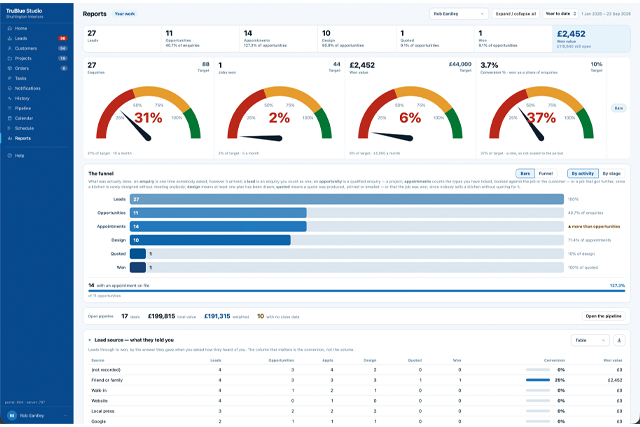
Martin says the move into CAD followed unsuccessful discussions about collaboration with other providers, as well as requests from retailers for alternatives. Launching market-challenging software was familiar territory, but CAD was unfamiliar ground – even with much of the catalogue data already available through TruBlue.
So his rationale is more about connecting the dots of the sales process of initial enquiry, design and the order and, he says, removing some of the repetition as users switch from one package to another.
“They’ll have a CAD system to do the drawing, then they’ll have a pricing tool,” he says. “Then they might have other things for a customer portal, or a fitters portal. They’re all separate bits of software and nobody’s talking to each other. So for the retailer or designer it’s lots of duplication after duplication.”
TruBlue says its ‘Studio’ brings those activities together, with CRM leading into design, pricing drawn from TruBlue’s catalogues and sold projects passed into the existing system for purchasing, delivery and stock management.
Accounting remains separate, while customer and fitter portals, mood boards and website integration form part of the wider package.
That addresses a recognisable frustration, but the integration will only matter if designers want to use the software. Martin’s argument is that CAD development has become too concerned with increasingly elaborate images, losing sight of the speed and simplicity needed to help secure a sale.
“At the start, this was going to be about speed and we weren’t even going to call it a CAD system. We were going to call it a kitchen planner,” he says. “So everything is very easy to get onto the plan and it’s just property-driven rather than true CAD based. So it just makes it much, much easier to learn.”
New systems
AI features include typed or spoken instructions to create rooms and add elements, alongside image enhancement using references for accessories and finishes. It has also accelerated development, Martin says, although his enthusiasm comes with an acknowledgement that the technology still needs direction.
“It can’t do everything for you and it’s like everything else. It makes mistakes. So it’s there just to speed things up,” he says. “In terms of software development, it’s massive. It’s made a great difference to us and we’re developing much quicker than we used to.”
The initial focus is British kitchen manufacturers, including smaller businesses able to add their own catalogues, with bathrooms next on the agenda.
For smaller manufacturers, that could make the link between design and pricing particularly relevant, allowing them to work with their own units and product codes rather than relying on a generic representation of what they actually currently supply.
For retailers, however, the calculation extends a long way beyond subscription costs. Learning a new system takes time, and bringing more functions under one provider places greater weight on its service and reliability. Martin’s challenge is to demonstrate that the time saved afterwards makes the upheaval entirely worthwhile.