
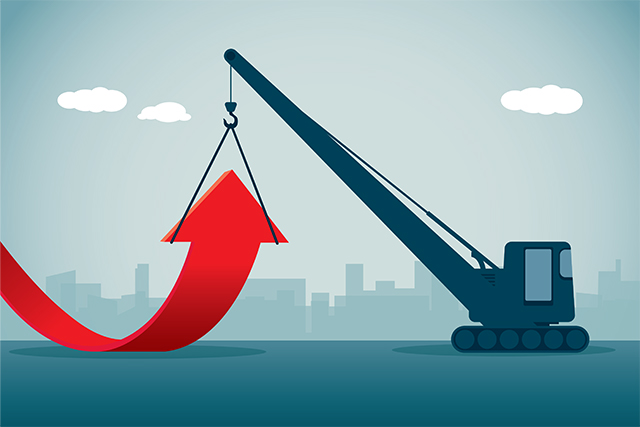
Opinion: Why your showroom growth has stalled
Aaron Rudman-Hawkins, MD of The Evergreen Agency, argues that when growth stalls in KBB retail, the issue is rarely effort or execution – but an over-reliance on a single channel that has reached its limit.
Words: Aaron Rudman-Hawkins | The Evergreen Agency
Growth in kitchen, bedroom and bathroom retail rarely fails overnight. It slows, plateaus, and then quietly stalls.
It is at this point many business owners conclude they have a marketing problem. In reality, they usually have something else entirely. In almost every case, growth hits a ceiling because the approach that worked before is being pushed beyond its natural limit.
Early success in KBB retail is typically driven by one dominant channel – local reputation, referrals or search. When that channel performs, the instinct is to double down: increase spend, run more campaigns, push harder. And this is precisely where the ceiling begins to form.
What is happening beneath the surface is relatively straightforward. Businesses are attempting to extract more from the same audience, with the same message, through the same channel. Performance does not suddenly collapse, but it does stop improving. Costs creep up, enquiries level out and each additional pound delivers diminishing returns.
The typical response is optimisation. Ads are tweaked, budgets adjusted, creative refreshed. These are sensible actions, but only when there is still headroom within that channel. If your growth model is built on a single source of demand, optimisation alone will not unlock the next phase. At that stage, it is not a marketing issue. It is a structural one.
Critical shift in thinking
Growth ceilings are rarely the result of poor execution. More often, they are the consequence of the aforementioned over-reliance on one channel, one audience and one way of generating demand. Businesses that break through these ceilings do not simply do more, they do things differently.
They move from thinking in terms of individual channels to building interconnected systems. Rather than asking how to generate more leads from Google, they consider what drives demand before a customer even begins searching. Instead of relying solely on paid activity, they develop supporting channels that reinforce one another.
For example, brand activity builds awareness and trust before a project is even considered; Email keeps prospects engaged during long decision cycles, and paid media captures existing demand. Reviews and referrals strengthen credibility and help reduce acquisition costs. Individually, each of these elements has limitations. Together, they create a compounding effect.
There is a simple principle at play. Sustainable growth comes from focus, not just activity. If everything depends on a single channel, growth will always be fragile. When channels work in combination, growth becomes more predictable and scalable.
For KBB retailers, this does not require unnecessary complexity. It requires clarity. Where does your demand originate today? What happens if that source slows? How are you creating demand, not just capturing it? Which parts of your marketing continue to deliver value over time?
If growth feels stuck, it should not be seen as failure. It is a signal. It is an indication that the next phase of the business requires a different structure, not simply more effort.
The retailers that scale successfully are not those who spend the most, but those who rethink how their growth operates beneath the surface.
That is where the real opportunity lies.