
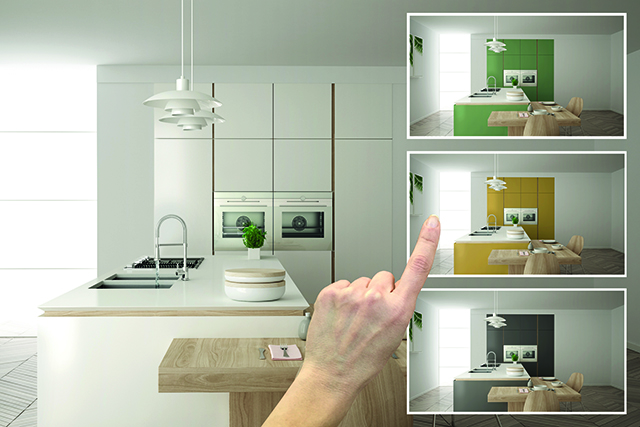
Will AI change how we use showrooms forever?
There’s still a lot of uncertainty around the long-term impact AI will have on KBB retailers. But Luxe Kitchen Designs owner, Luke Niblett, believes just like the rise of the internet, the industry is ripe for pivotal changes…

Luke Niblett, owner, Luxe Kitchen Designs.
Over the last decade, the KBB industry has changed dramatically, and retailers have had no choice but to adapt. The traditional showroom-led model that once dominated the industry is no longer enough on its own.
Customer behaviour has changed, expectations have changed, and the way people buy kitchens, bedrooms, and bathrooms has changed with it. From the decline of the high street, to the rise of online research, through Covid and now into the age of AI, our industry has had to constantly evolve to stay relevant.
It started with the high street becoming quieter. Retailers had to rethink how they attracted customers and stayed visible. Fewer people were casually walking into showrooms, which meant businesses could no longer rely on location alone to generate leads.
At the same time, we saw a major rise in DIY-led projects, with more homeowners designing their own kitchens and bathrooms, ordering products online, and managing installers themselves rather than relying on the traditional showroom experience.
As the internet changed consumer behaviour, we then saw a major shift in how quickly customers expected information. Clients no longer valued the time and expertise involved in designing and quoting for major projects in the same way. Increasingly, we found ourselves receiving messages the day after a survey appointment asking, “Have you priced this up yet?” or “Can you send the designs over?”.
At the same time, customers were also being exposed to huge amounts of misinformation online, often driven by misleading offers, unrealistic pricing, and headline discounts that rarely reflected the true cost of a quality project. Retailers were now expected not only to sell, but also to educate and rebuild trust.
Covid also had a strange impact on our industry. It feels wrong to say it had a positive effect, but in many ways, I believe it did. We saw a huge surge of enquiries during that time, which helped many businesses through an uncertain time, even if that was followed by a couple of slower years.
More importantly, Covid forced retailers to re-evaluate how they operated. We had no choice but to adapt to video calls, digital presentations, online approvals, and virtual design consultations. It proved that customers were far more comfortable buying remotely than many of us had assumed. It also exposed just how expensive, and in some cases unnecessary, the traditional showroom model can be.
This shift is exactly why our own business operates without a traditional showroom. Instead of investing heavily in expensive retail space, we focus on design, service, and giving customers access to quality products at sensible pricing. By keeping overheads lower and working closely with local manufacturers, we can deliver a more personal experience without the inflated costs that often come with the old showroom model.
AI and Design
According to KBB design software Houzz’s inaugural State of AI in Construction & Design Report released last month, almost half of all design firms in the UK (46%) are now using Artificial Intelligence (AI) to complete everyday tasks. Amongst design firms specifically, 31% said they use AI technology on either a daily or weekly basis, and roughly 22% said they tinkered with it on a monthly basis.
One-in-five (20%) said they don’t use AI at the moment but were exploring its uses, and a staunch 27% said they didn’t use AI in their business and were adamant that they had no plans to.
Houzz found that within businesses that use AI regularly, 88% said that it was used to complete administrative tasks, roughly half (48%) use it for sales and marketing, 40% use it for planning and design, 36% use AI for project and client management, and a quarter of businesses (24%) used the technology to handle things such as business operations and reporting.
The AI age
Now, as we enter the age of AI, we are seeing another major shift in customer behaviour. Customers are using AI tools to research layouts, compare products, generate design ideas, and even challenge professional designs before they ever step into a consultation.
We have already had clients take our designs, run them through AI tools, and send them back with suggested changes. It is not far from a world where customers will attempt to design entire projects themselves using AI alone.
However, just like when the internet arrived, and just like during Covid, the real opportunity is in adapting rather than resisting. AI can actually make it easier for customers to find the right retailer. As an example, someone can now ask an AI engine to find a kitchen retailer that specialises in Scandinavian design, has strong reviews, and is transparent on pricing, and the system will pull together evidence from reviews, projects, and online presence to guide that decision.
As a millennial, I grew up with one foot in the old world and one foot in the age of technology, and I understand the balance that comes with that. We still believe in old school customer service.
When a customer calls me, I answer. But behind the scenes, we have built our own automated CRM, project management, and quoting platform that allows us to work faster, communicate better, and create a smoother, more efficient experience for clients, installers, suppliers, and manufacturers.
This balance is what I believe keeps KBB retailers relevant. Customers still need expertise, trust, problem solving, and genuine service. Technology should support that, not replace it.
Status quo?
That same thinking is also why we are now franchising our business model. For too long, the industry has told designers that success means opening an expensive showroom, taking on huge overheads, and being tied to one location.
We are questioning that status quo. A modern franchise model gives designers more power, more independence, and greater earning potential without the burden of the traditional retail setup.
By removing unnecessary overheads and focusing on design, systems, and customer experience, designers can build stronger businesses with better margins and more freedom. It creates an opportunity for talented kitchen, bathroom and bedroom designers to operate like true business owners, not just employees tied to outdated models.
The businesses that will thrive in the future will not be the ones holding onto the past. They will be the ones willing to adapt, embrace change, and build smarter ways of working while still protecting the expertise and service that make this industry valuable in the first place.