
Opinion: Retailers, who are you REALLY dealing with?
With the threat of silicosis now a national news item, Clare Howcutt-Kelly, communications officer for the Worktop Fabricators Federation, believes retailers have a unique role to play in helping to prevent further cases.
Words: Clare Howcutt-Kelly
By the end of this article, you’re probably not going to like me very much, but I’m okay with that.
What I’m not okay with is somebody calling me, crying, telling me they’ve just been diagnosed with silicosis. I’m not okay with that at all.
For possibly years now, we’ve heard more and more about the threat posed by silica dust and the devastating consequences of exposure. We’ve seen newspaper investigations, increasing awareness and, tragically, more people being diagnosed with this deadly and preventable disease.
So now we need to ask ourselves a difficult question: Do I have a part to play in this? And perhaps more importantly: am I responsible for how the people working on my projects are treated?
The answer, whether we like it or not, is yes. We all have a part to play in the fight against silicosis. Let me put it another way. If you work in a role where you advise clients on materials, or if you’re a kitchen designer having conversations directly with customers about what they should choose, how much are you actually considering? Are you thinking about what the material is, where it comes from, its composition, its provenance and its credentials — and then stopping there?
You could choose the most ethical material possible. You could trace it right back to its source. You could choose a low-silica material. You could choose natural stone. You could choose any material you like, with whatever silica content it has. But the material isn’t the end of the story. Someone has to work with it.
And dust, in whatever form or from whatever material, presents a risk that has to be properly controlled. That is the bit of this conversation that I think we sometimes miss.
But here’s the good news: there is actually something you can do. Something that can help you sleep better at night, knowing that you have taken reasonable steps to make sure you are not contributing to somebody else’s suffering.
Say you’re working on a project and you’re specifying a material. You’ve done your due diligence. You’re satisfied that the material is responsibly sourced and that, to the best of your knowledge, you’ve made an ethical choice.
Now ask yourself: Who are you working with? Who takes that beautiful piece of material and turns it into something your customer will enjoy for years to come? The fabricator.
So, do you know who that fabricator is? And, perhaps more importantly, do you care? There is no excuse for not caring about the person who is working on your project.
I would urge you – urge you – to go and visit the fabricator you work with.
If you haven’t visited them, and nobody on your team has visited them, how can you possibly have confidence that the people involved in your projects are being kept safe?
I’m fortunate enough to have visited many different workplaces over the years: fabricators, stone yards and everything in between. And one of the things that concerns me is just how much misunderstanding and mis-education there still is around dust and the risks associated with it.
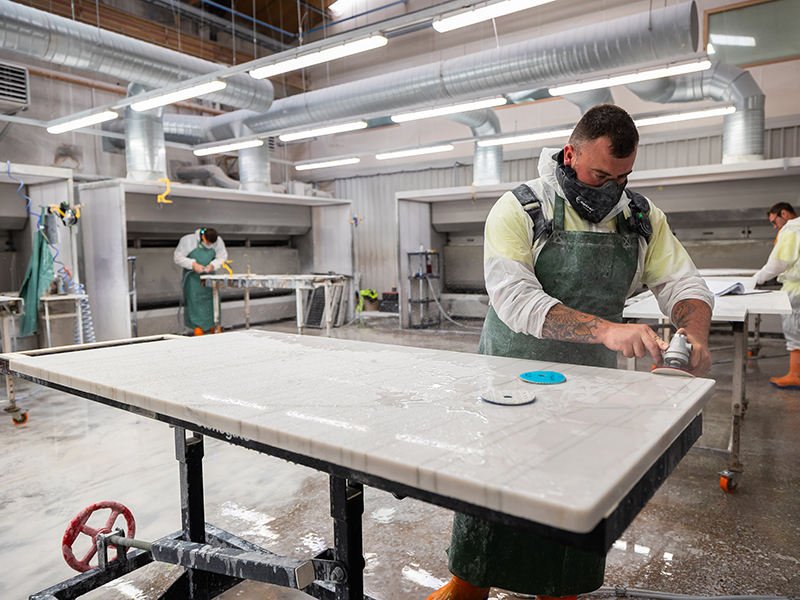
So, if you’re visiting a fabricator, start with your instinct. Can you breathe comfortably in there? Are you covered in dust? Does the environment look safe? Would you want a member of your own family working there?
If the immediate answer is no, then why the hell are you still there? And why the hell are you still working with those people? A fabricator that takes the health and safety of its workforce seriously should have no issue with you wanting to understand how they work.
If they don’t want you to visit, that should at least make you stop and ask questions. Look at how they work. Ask what measures they have in place. Ask how they manage dust. And then look at the people. Do they seem happy? Do they seem safe? Does it look like somewhere you would be prepared to work yourself?
The Worktop Fabricators Federation (WFF) brings together fabricators who are united by the belief that the health and safety of their workforce matters. Its members share information, collaborate and work together because sometimes the greater good has to be more important than individual gain.
I know that people are naturally concerned about what they can actually do. You might be sitting there thinking that this is a problem for somebody else — the fabricator, the manufacturer, the regulator, the industry. You might even feel powerless.
But I assure you: You are not powerless. You can instigate change from wherever you are. You can ask questions. You can visit the workplace. You can challenge poor practice. And, ultimately, you can choose who you work with.
This isn’t simply a case of tracing a material back to its source and congratulating ourselves because we’ve made an ethical choice. This is a matter of life and death.