
Are you sitting on the industry’s strongest green credentials?
Could you be sitting on one of the KBB industry's strongest green credentials without even realising it? Lawcris certainly thinks that's possible, and is running its new Materials Matter session to get the message out.
This article is sponsored content
What if one of your most valuable sustainability credentials wasn’t something you had to invest in, install or certify? What if it was already built into almost every kitchen, bedroom or furniture project you manufacture?
Most businesses in the KBB sector are constantly looking for ways to demonstrate their environmental credentials. Yet many may be overlooking one of the most powerful sustainability stories available to them: timber.
As children, many of us were taught a simple message: cutting down trees is bad. Images of rainforest destruction and deforestation shaped how we view forestry today.
The problem is that responsible forestry is often mistakenly placed in the same category. The KBB industry may be sitting on one of its greatest untold stories. The question is: are you using it to add value to your business?
Most of us are aware that as trees grow, they actively remove carbon dioxide from our atmosphere and lock it away within the wood. This carbon isn’t released when the trees are cut down, when they are harvested and transformed into kitchens, bedrooms and furniture, that carbon remains stored within the finished product for decades.
Meanwhile, new trees are planted and begin the process all over again, removing even more carbon from the atmosphere as they grow. It’s a continuous cycle: one generation of trees stores carbon in the products we use every day, while the next generation gets to work capturing even more.
A sustainably managed forest is harvested, replanted and regenerated over decades. Like a farmer grows crops, foresters grow trees, but with an incredible added benefit.
There is so much more to this story to learn that you can share with customers. That’s what makes timber so remarkable. It doesn’t just come from nature, it helps nature keep working.
Now, imagine being able to explain to customers not only how a kitchen looks, but how the materials used to create it originated from a managed forest, support a renewable supply chain and continue storing carbon throughout their lifespan. That’s a conversation that adds value.
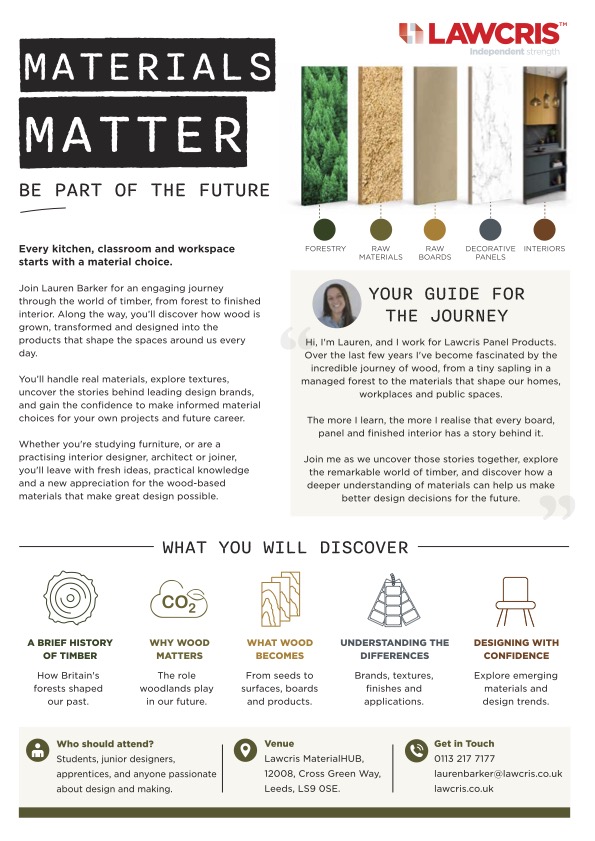
This is one of the reasons Lawcris created Materials Matter, a series of free, tailored educational sessions, each adapted to suit its audience, delivered by Lauren Barker at the company’s dedicated learning space, the MaterialHUB in Leeds.
The aim is not simply to teach people about timber. It is to help businesses understand how material choices connect to wider sustainability goals and how that knowledge can be confidently shared with customers.
With a background in marketing, Lauren approaches the subject from both a materials and communications perspective. Attendees don’t just learn about timber, carbon storage and responsible forestry. They learn how to translate that knowledge into compelling messages for websites, social media, brochures, showrooms and customer conversations.
Materials Matter doesn’t just explore the benefits of timber; it encourages informed conversations about the challenges, compromises and responsibilities that come with managing our forests and the supply chains. Understanding the story is only half the challenge. The other half is knowing how to tell it. The forestry sector cannot tell this story alone. The joiners, retailers, manufacturers, designers and merchants who work with timber every day all have a role to play.
The question isn’t whether the KBB industry has a great sustainability story. The question is whether we’re making enough of it.
To learn more about Materials Matter and discover how your business can better communicate the sustainability benefits of wood-based materials, please contact Lauren Barker at [email protected].
This article is sponsored content