
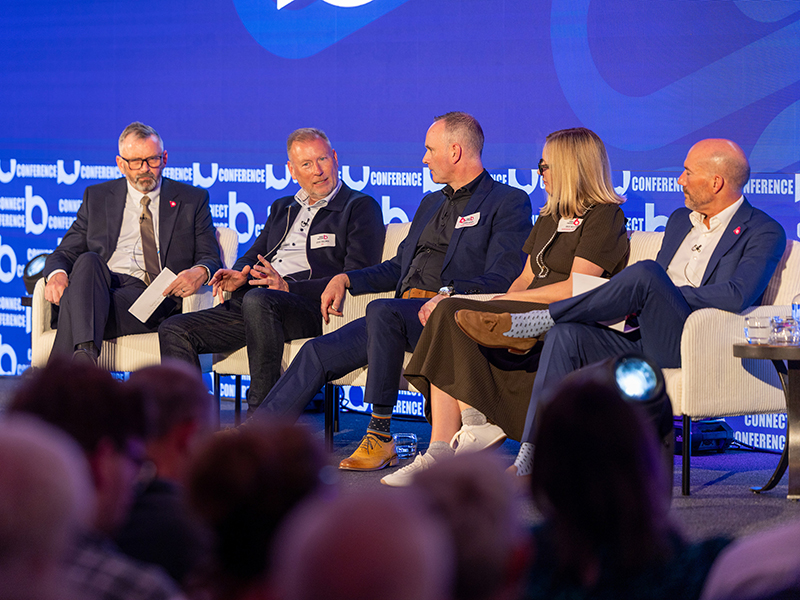
Panellists at this year’s Bathroom Association Connect Conference explored a range of potential solutions to fix the ever-present industry skills gap, saying the problem was creating “an artificial ceiling” on the number of products that can be fitted for homeowners.
Chaired by Bathroom Association technical director Andrew McLean, The 2026 Connect Conference panel was made up of Steve Collinge, managing director of Insights Retail Group; Simon Acres, owner of Simon Acres Group; Jonathan Samuel, managing director at Water Regs UK; and Julie McLean, UK marketing director at Hansgrohe UK, who is also the association’s new president.
Asked how the panel believed the industry could overcome the problem when it likely will require significant investment from suppliers, Simon Acres said: “You have to go back to how can we practically and directly support its adoption across the industry. There is a big concern among suppliers that if this isn’t supported on a wider scale, the problem will eventually be that there isn’t going to be anyone to sell or fit the products that we’re selling.
“If there’s more people coming in to the industry, we can fit and sell more products, so there is a definite commercial benefit to the companies in this sector to get behind this in a collective way.”
Steve Collinge added that he believed the skills gap problem was causing an “artificial ceiling” for the industry, with a finite number of tradespeople available to actually fit the products supplied by manufacturers. He continued: “If we get a handle on this, you could completely blow that ceiling. There was a concerning statistic recently that said 60% of bathroom tasks and projects don’t get done, either because consumers can’t find a plumber, or they find the process too complicated.
“That means there’s an absolute vested interest from everyone in this room to get more projects completed, and one of the clearest ways for that to happen is by opening the door to get more people in this sector.”
Discussing the lack of widespread investment to solve the problem so far, Jonathan Samuel commented: “I think sometimes you need to invest and be confident that you’re going to get a return on that investment. And we know that more people coming to be the future of the industry is the only way the industry can have any future.
“Everyone talks about needing a return on investment for skills to make it work, but there could actually be a much more immediate return on that investment than people realise, especially considering how dire this problem could be if it goes unresolved.”
Building on this point, Collinge added: “We’re not short of the parts needed to make this work. A lot of people talk about the challenges of making this industry look appealing. But we’ve got all these brilliant products, and we actually change people’s lives. Every single individual product this industry sells enhances someone’s life, and the good feeling that they get from a new bathroom can last for weeks, months or even years. And we do that as an industry – we transform people’s lives.
“If we can get better at relaying that message, beyond functionality and the products that we sell, that would go a long way towards making this industry more appealing to the people we need to bring in. But we’ve got to all get behind that narrative as an industry, because it will need a collective change.”
Julie McLean also touched on the importance of getting the “narrative” or “messaging” around the problem right, adding: “It has to all be connected, and it all needs to work together at the same time, because that’s the message we’re trying to get across to people who potentially don’t understand this. There’s a lot of different industries also struggling with this, which is why we all need to pull together.
“I think we need to find a way to almost commercialise the challenge that’s in front of us, and have everyone feeding into it. That’s what I feel is that there are some really passionate and enthusiastic companies doing a huge amount, but I don’t think it’s having that groundswell that it really needs yet.”