
Shining a spotlight on 2025’s lighting trends
We turn our attention to kitchen and bathroom lighting, exploring the latest trends and different approaches for kitchen and bathroom design, with a special focus on smart lighting…
Words: Fran Seden
Lighting is the key foundation for any kitchen or bathroom scheme. It’s transformative, adds depth, highlights key features and is essential for function and ambience.
It’s been said in the past that lighting is an afterthought as far as the design goes, but I’m not sure that’s the case anymore – and the level of innovation and new products available indicates that the market is certainly not neglected.
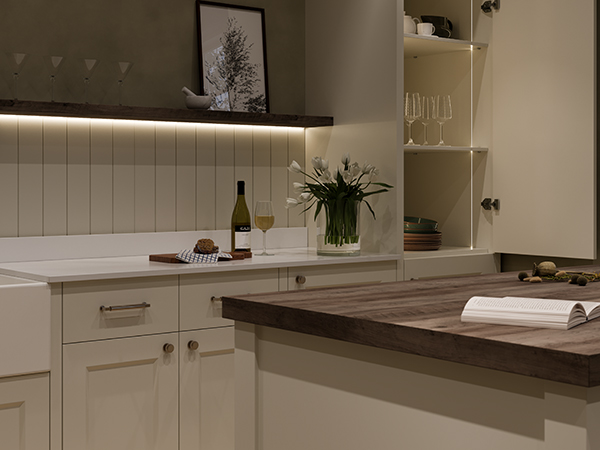
From LED profile lighting strips for under cabinets and open shelving in cool or warm tones, COB lighting, IP-rated lights with PIR sensors, and slat lighting, to dramatic back-lit walls and islands, statement pendants and expertly positioned accent lighting, there is something to suit every purpose, whether it’s functional spotlighting, or just setting the ambience. And we’re not even on to smart lighting yet, (we will talk about that later).
“In 2025, lighting is all about layering”, says Ashley Smith, sales and marketing director for Leyton Lighting. “No longer a one-size-fits-all solution, the modern approach combines ambient ceiling lights, task lighting under cabinets, and stylish accent lighting to add both function and flair. We’re also seeing a move towards warmer light tones—tunable whites and dim-to-warm LEDs that mimic the natural changes in daylight.
“On the design front, statement pendants are leading the way – think oversized, sculptural forms in natural materials. Technology is also making its mark: smart lighting systems now offer zoned control, colour temperature adjustment, and automation – all designed to boost energy efficiency, safety, and comfort. And let’s not forget colour and mood lighting. RGB LEDs and backlit panels are transforming splashbacks and surfaces into dynamic design features.”
A layered look
Thinking about how kitchen and bathroom designers should approach lighting schemes, there was a general consensus among our experts that the basis should be focused on functionality, with layering from that point to build in ambience and atmosphere.
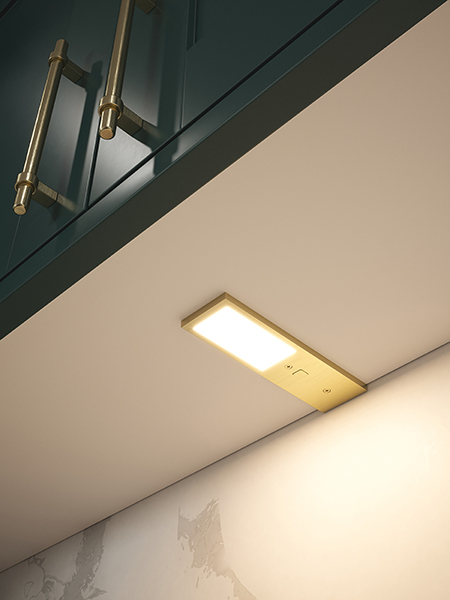
So, for the kitchen you might put in overhead spots, task LED strips beneath wall cabinets to illuminate areas of the worksurface that are often otherwise wouldn’t get much light, and then add feature lighting, such as a pendant over an island or dining table.
Cooker-hood lighting also plays an increasingly significant part in adding to the overall scheme, offering the obvious task lighting, but also ambience.
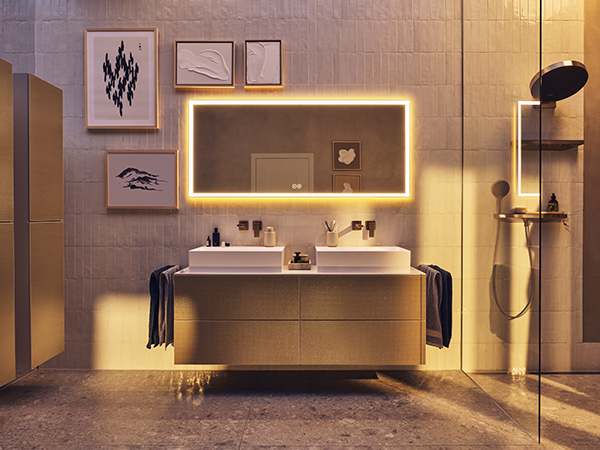
In the bathroom, the task lighting might be around the illuminated mirror, with colour-temperature spots overhead so the user can change from cool to warm.
Angela James, marketing manager at Sycamore, explains: “Lighting that can shift between warm white, natural white, and cool white at the touch of a button is becoming increasingly popular, offering flexibility to suit different moods and times of day.
“There is also growing demand for lighting with integrated features such as dimmers, motion sensors, and smart controls that enhance convenience and energy efficiency.”
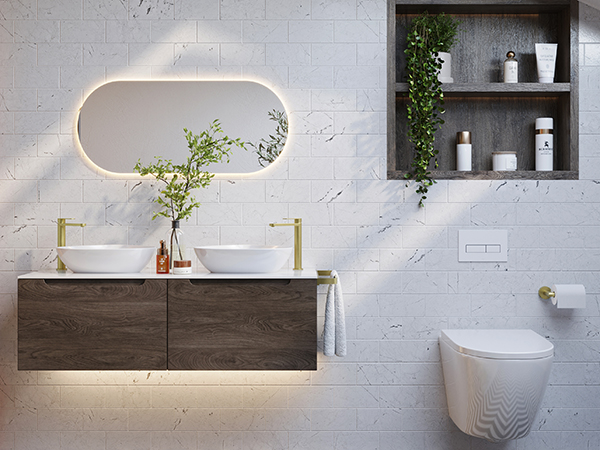
LED strips can also be employed to great effect in the bathroom to inject ambience and highlight features – in niches in the shower cubicle, around the vanity, beneath wall-hung furniture or the bath, while dimmable bathroom lights can also help set the ambience.
A WC with an integrated sensor light can also be a great addition, for guiding sleepy homeowners to their target, without fully waking them.
TLW’s marketing manager, Eleanor Johnson, adds: “Safety and zoning take priority. Designers should specify IP-rated products and layered lighting that allows the room to shift between practical and spa-like settings.”
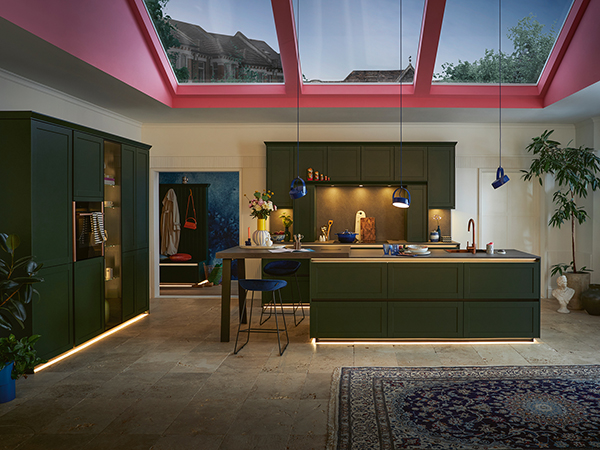
Offering some advice for setting out a lighting scheme, Jenniefer Roberts-Holt, marketing lead at Sensio, notes how kitchen lighting can feel overwhelming when you’re trying to work out what to include to enhance the design. “But our top tip? Keep it simple in the early design stages. Just make sure to account for two plug sockets on each wall that will have kitchen unit – one for the base units, and one for the upper units. That way, no matter what products you choose later, the layout can be tailored to each customer and you’ve already got power in place for your lighting scheme.”
Stuart Dance, managing director at InHouse Inspired Room Design, adds that lighting also has accessibility benefits and can be strategically positioned to enhance visibility, whether that’s spotlights built in above the cooker or installed within shelving units, or built-in LED lighting for grip ledges, pull out drawers or recesses.
“A human-centric lighting approach allows retailers to take a bespoke and tuneable approach tailored to a customer’s individual needs and preferences.”
On this accessibility point, Rotpunkt’s head of UK sales, Matt Philips believes that it’s wise to consider how lighting can boost hazard perception and help end users to efficiently prepare and cook food, as well as boost safety in an inclusive kitchen, given the increasing number of multi-generational households.
“It is reported that over 65’s may require double the light levels when compared to people in their 20’s so lighting in the kitchen needs to be a key consideration at the concept phase and factored into storage provision in addition to the task zone and dining/entertaining zone.
In terms of how the approaches between kitchens and bathrooms differ, TLW’s Johnson notes that bathrooms demand a higher degree of technical consideration, specifically around IP rating and moisture resistance, and says that in bathrooms, lighting should create a sense of calm, luxury, and relaxation. Kitchens tend to be more open-plan and multifunctional, requiring lighting that adapts from food prep to socialising.
All-natural
Another key difference between kitchens and bathrooms is the amount of natural light each of these rooms tend to enjoy – kitchens have lots, with plenty of windows, potentially skylights and glazed doors. Bathrooms tend to have little, if any, so designers need to be more creative to introduce light. And the interplay between electric light and natural light is critical. Natural light should always be maximised where practical and possible, for its many known benefits – boosting mood, and helping to regulate one’s internal body clock.
Bathroom Brands’ head of design, Jorge Hernandez, comments: “Any light, whether it’s artificial or natural plays a key role in a space. The interplay between the two is also a key consideration in bathroom design, with wall lights, ceiling lights or shower lights, for example, creating geometric shadows throughout your space, which adds to the dimension and feel of the room.
“Natural light has the potential to bring a cyclical and ever-changing light throughout the day which again adds to the mood of the space and will impact how and when you choose to use your artificial lighting.”
TLW’s Johnson concludes that in north-facing rooms, or in rooms with limited natural light, careful use of warm-toned or natural-white LEDs can also work together to ensure consistent and comfortable illumination.
Smart lighting
Smart lighting, according to all our experts this month, is gaining traction and is likely to become the norm in the future.
As Sensio’s Roberts-Holt notes: “With mobile apps and voice-controlled systems, it offers personalisation, convenience, and energy savings – all things homeowners are looking for. As technology gets easier to use, smart lighting is likely to become standard in most modern kitchens and bathrooms.”
Smart lighting products are more affordable and accessible than ever, making them viable for a wide range of projects, and no longer reserved for the top end of the market. “From retrofit solutions to integrated systems in new builds,” adds 4Lite’s marketing manager Rachel Morris, “smart lighting is now a realistic and attractive option for the mainstream market.”
In terms of the benefits, there are many to sell to customers – the potential energy savings that they offer, and the convenience. “Remember going on holiday and realising someone had left the bathroom light on for 10 days?” says senior designer and showroom manager James Delgado from Ripples Wokingham, “Now, with smart tech, we can simply log in from our phones, switch off the lights remotely, and check everything’s as it should be.”
Thinking about how far smart home integration will become part of the KBB retailer offering, our contributors agreed that, for the most part, simple plug-and-play systems are perfectly suitable for the needs of most people.
“Many systems now work with voice assistants or smartphones right out of the box, so you don’t necessarily need to be a smart home specialist to offer a smart lighting solution,” Ashley Smith continues. “For most clients, the off-the-shelf options are more than sufficient and offer fantastic flexibility.”
Sustainability and efficiency
Rocketing energy bills over the past few years, combined with a greater consideration for environmental matters, means that consumers are perhaps more interested than ever in the most efficient and eco-friendly options available.
TLW’s Johnson adds that “consumers are increasingly aware of energy ratings and lifestyle costs, while building regulations continue to push for more sustainable outcomes.”
Innovation and advancements in lighting technology make makes it possible, and each of our contributors make a point of pushing the eco-credentials of their products, with most manufacturers offering super-efficient LEDs as standard. Leyton’s Smith adds that, “when paired with smart controls, unnecessary energy usage can be cut down even further.”
On those building regulations that Johnson alluded to, 4lite’s Morris notes that “on the regulatory side, the push is even more pronounced with the Future Homes Standard and Part L of the Building Regulations stipulating the use of energy-efficient solutions throughout new buildings.”
Finally, it’s worth pointing out that, although these more energy efficient lighting solutions might have a greater upfront cost, consumers are likely to get their money back, and then some, through reduced energy bills and less frequent replacing of bulbs.