
Laurence Llewelyn-Bowen wants to save the modern kitchen
British design legend Laurence Llewelyn-Bowen is on a personal crusade to save the public from the horrors of dull homes. And he’s partnering exclusively with independent kitchen retailers to help spread his gospel…
It’s probably no exaggeration to say that Laurence Llewelyn-Bowen has ascended to the pantheon of British pop culture iconography, primarily through being the face of TV’s Changing Rooms.
Launched around the turn of the millennium, the show essentially paved the way for the hundreds of interior design programmes that have dominated TV schedules for the past few decades, and it was based entirely around putting bold design ideas into the hands of everyday people.
Famous for his flamboyant nature and eccentric sense of style, Laurence Llewelyn-Bowen still seems to personify all of Changing Rooms’ best aspects, even almost 30 years on from its launch.
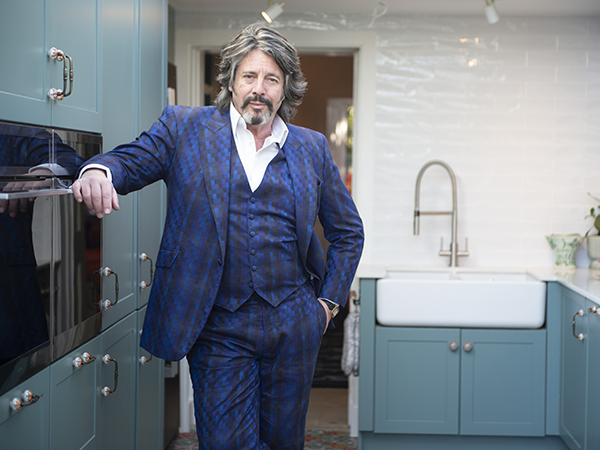
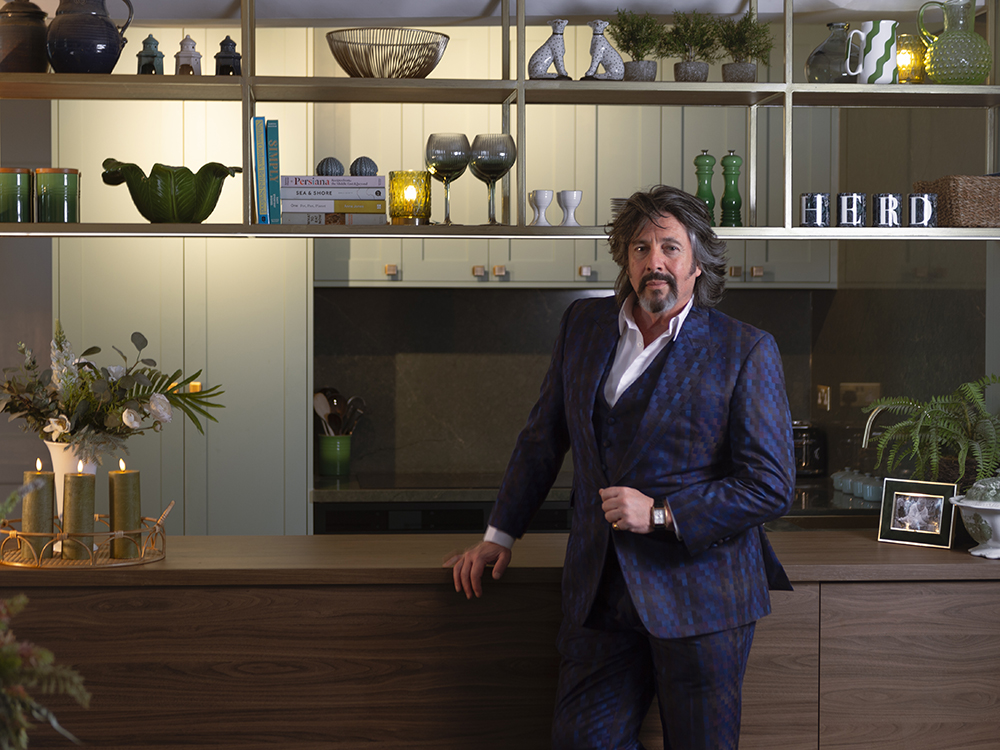
You can picture him easily: on the morning when he spoke to kbbreview about his new kitchen collection, it was no surprise to see Laurence appear – although only through the medium of video call – in full regalia, complete with a trademark loud, floral suit and bundles of energy.
Partnering with Exeter-based manufacturer System Six, this year the legendary designer is bringing his equally jazzy and bold Quintessential kitchen collection to market, and he’s chosen to do it exclusively through the independent retail channel.
And, in a funny kind of way, he’s also returning to his Changing Rooms roots, saying he’s on a one-man mission to add a bit of comfortable chaos to the lives of everyday Brits.
Because to Laurence, being at peace with your own living space is essential for a happy life.
“Being at home is the only moment where you are actually surrounded by your own personality,” he declares, “It’s all about taking your bra off, letting your hair down, and having a couple too many glasses of gin…”
Where did the spark for your new Quintessential range come from?
There was nothing more disappointing than looking at the average kitchen of the noughties – or the 2010s even. It was this sort of ridiculous continental inspired machine for cooking in. Kitchens are actually there to be the center of the family…the pivot around which hearth and home spin. Going back 150 years, most families in this country would have treated the kitchen as this incredibly hardworking, very nourishing space in which they did most of their living.
But I think we’re beginning to reset the way we look at the home, and beginning to question the absolute barking mad concepts that were codified in the 20th century. And I think one of the big expressions of that in the home has been the reclamation of the kitchen – the kitchen revolution that has inspired most people in this country to not want the kitchen as just something that you show off to your friends. Where you can’t actually put a soupy spoon down on your incredibly high maintenance Italian work surface. Actually, the kitchen wants to be – needs to be – somewhere where all the love comes from.
So is that the basis for your new collection?
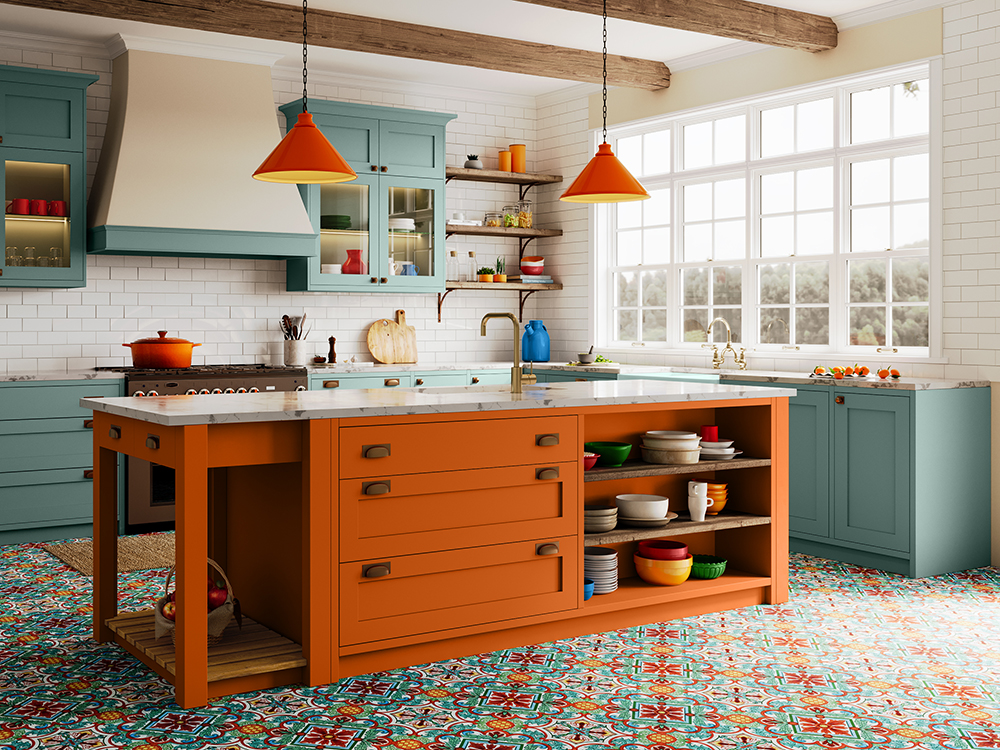
The Quintessential concept is essentially my kitchen manifesto. I was very, very keen to use specific psychological starting points for the most perfect kitchen. For example, the Cuisine Kitchen, which is the kitchen that I created for myself, is very much keyed into the kitchens that I remembered as a child that were full of love. There was a mini reset that happened in the early 70s after the oil crisis. It was the moment that everybody moved away from space age design, where kitchens actually became all about Le Crueset living. Things like Mediterranean tiles and bubbling vats of goulash or spaghetti bolognese. I felt very strongly that what needs to happen now is to bring emotion back into sight.
But how do you design a kitchen range around emotional states?
You start getting excited about the kitchen that you feel you deserve! A kitchen is the most expensive thing you’ll ever buy in your home, no doubt about it. What was really breaking my heart was this idea that people were spending an enormous amount of money on something that actually wasn’t what they wanted. I think in the last decade, there was a ridiculous, phenomenal, stupid amount of conspicuous consumption, where actually the amount of thousands that you spent on a fridge was the most important thing. But I think that’s the most morally, emotionally, spiritually bankrupt way of decorating any space.
Alright, so where did your design process begin?
It came very organically out of the fact that I needed to design a kitchen for myself. We split the house into two, with me and my wife Jackie on one side, and my daughter Hermoine on the other. We wanted to be practical, but we also wanted our kitchen to be a bit flashy. And for Hermoine, we needed to do something that fitted in with the fact that she’s got two small children, but they just want to be able to make coffee and unpack their UberEats. And that’s when I started working with System Six, and started thinking about casting that net even further and understanding that there were other psychologies at work in the way that people conceive their kitchens.
Can you give me the quick overview of the other designs in the range?
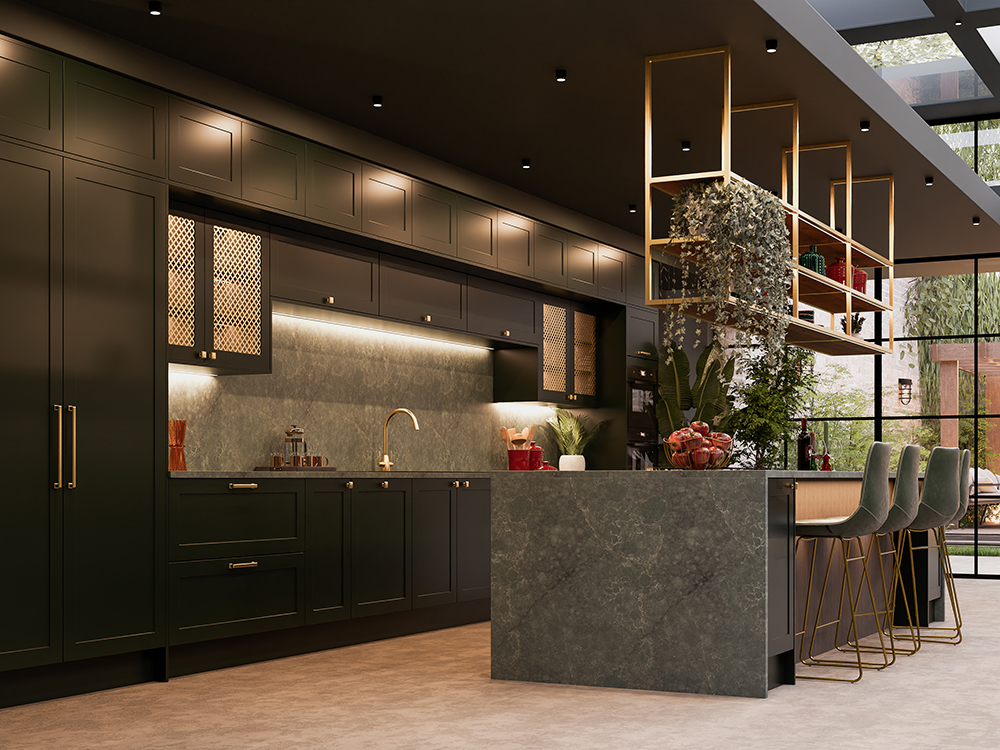
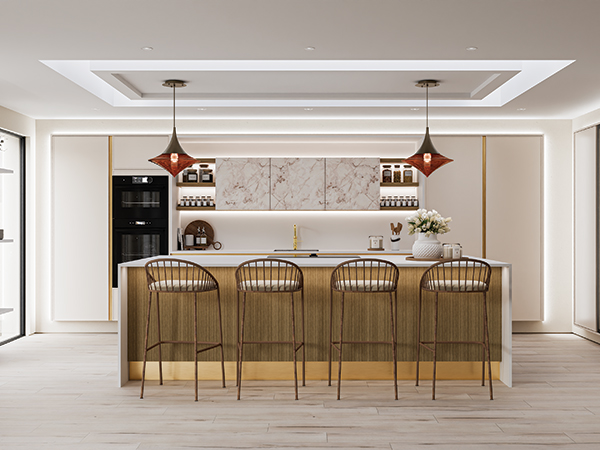
Albany, which is what Hermione’s got, is sophisticated. It’s actually based on furniture rather than kitchen. So it’s very much conceived as a concept that fits into a larger space if it needs to. Cashmere is my kind of deliberate evocation of this concept of quiet luxury that shows how actually neutral is fine – neutral is good – but you need to design neutral in a sexy way.
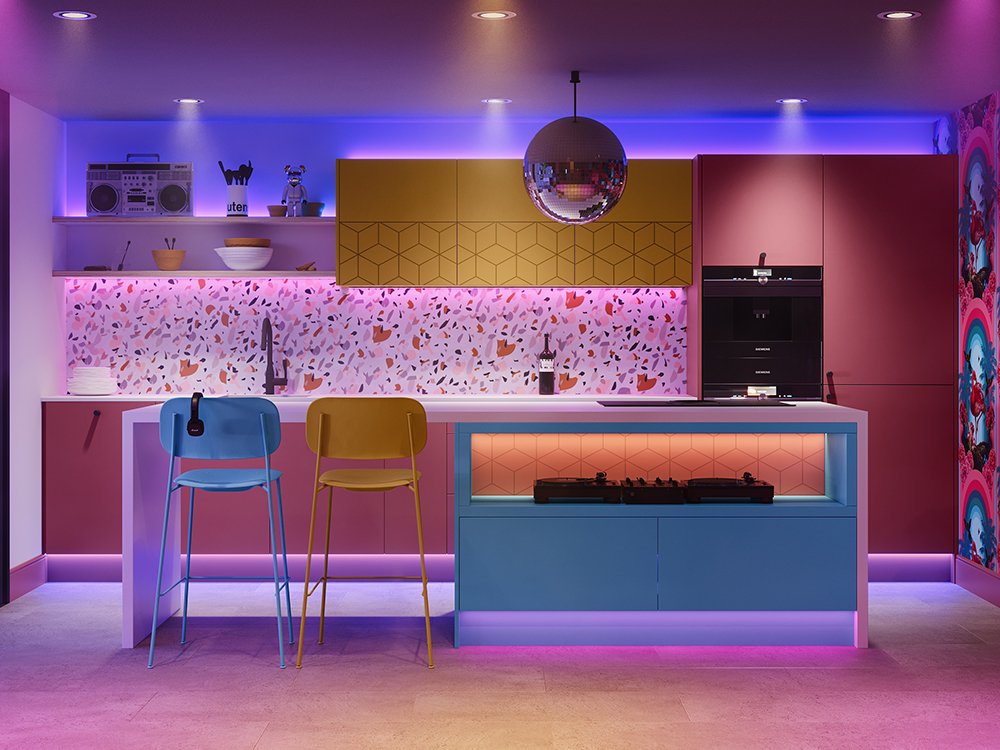
And then there’s Kitchen Disco, which is probably a lot of people’s worst nightmare, but then for some people it seems it’s their wet dream for a kitchen! It is a disco ball. It is flamingos. It’s strong pastel coloured terrazzo. People are crying when they buy it! And because these have got such cogent, such easily digested names, it means that the customer absolutely gets it – it’s literally bringing emotion into that kitchen space.
Given your notoriety in the design world, you could essentially take this concept to any of the big national kitchen companies, so why didn’t you?
Basically, I was fending off the big names, all of whom wanted a Llewelyn-Bowen kitchen. But I remember sitting in one of the meetings, and I was just given a long list of things that they didn’t want me to do. The other thing is, when you’re dealing with multiples, they have to find something that’s going to work across 300 or 400 showrooms. And they’re not going to want something that is going to stimulate you too much, because what they don’t want is a Llewelyn-Bowen kitchen in their showroom which then overshadows their unbelievably boring grey boxes. Whereas System Six was just incredible in all of this – they totally get it.
And that led to you partnering exclusively with independent studios?
Firstly, it gives me great pleasure and great pride to bring a bit of emphasis and a bit of energy back into the high street. But actually, I’m now dealing with people on a very personal level, and they are basically brand ambassadors. So everyone that now stocks a Quintessential Kitchen is basically part of my team. Independents are operating as part of a wider community, and you don’t get that with a big multiple. I mean, I’m sure there are great managers out there and, I don’t want to diss them at all, but fundamentally they are managers – they are not owners.
So I am getting to the people that really do have their business balls on the line. They rise or fall entirely based on their reputation within their community. So if they do a rubbish install, then everyone’s going to be dissing them. But actually, they’re the ones that go that little bit further. And I want my kitchens to be all about that.
I guess there’s also the risk of losing a bit of your brand ethos if you go to a big multiple as well, isn’t there?
You completely lose control! You know, I promoted Möben for a while, which was extremely lucrative for me, I’m not going to lie. But, ultimately, my social media feeds would be full of people who were unhappy. And I found that very, very difficult. I don’t want that to happen. Especially not to people who put all their financial eggs into this one basket. And of course, Möben folded, and I remember getting on a plane and I got a slow hand clap because there were so many disenfranchised Möben customers.
And has that shaped how you want to do business now?
That really taught me a massive lesson. The thing is, if I was out there designing those kitchens and they didn’t work because they were too “me”, then I would have no problem with it. It’s fine. But actually, I was sucked into this kind of vacuous business deal where they were basically just using my face to be the voice of their own moody kitchens. So, the Quintessential project is absolutely the reverse of that. I’ve designed everything, and now I’m giving it over to the Quintessential dealer to then make it their baby.
What’s the reception been like from the retailers you’ve got so far?
I think what the dealers are particularly excited about is that the Quintessential concept is four psychological brands, but it’s fundamentally about a design palette. And that’s why it’s so important to be working with the independents, because I need to be working with designers, with people that are excited about taking these design concepts and fitting them into their client’s life.
It’s interesting hearing you talk so much about consumer tastes, because a lot of suppliers now talk about things like “democratising design”, and making design accessible for everyone, and I think that was really kicked off by shows like Changing Rooms...
I mean, if there’s one thing that I’ll have engraved on my gravestone, it’s a term like “democratic design”, because actually you’re absolutely right. This is where I started. Before I did Changing Rooms, I was doing incredibly upmarket, very posh, very expensive design. And the whole confrontation with the show was this idea of taking highfalutin la-di-da interior designers and putting them into council estates.
I think what took everyone by surprise is the fact that I bloody loved it! Before, I’d have clients with private planes waiting and we’d go to pick taps out in Italy or whatever. But for the show, I’d have to go to B&Q and find paint, or I had to think of a different way of using MDF or whatever. That sense of adventure was like uncharted territory.
A lot of independents say that the market’s in a really difficult place right now, so what’s your advice to them?
My god, trust, in the kitchen market, is the most valuable thing in the world. You need to understand you’re actually there to empower your customer – to help them get the kitchen they’ve always wanted. I’ve discussed with System Six what to do if the customer gets halfway through ordering Kitchen Disco and thinks “I’m not sure I can do it… I’m not sure if it’s me”. Retailers need to say: “It’s about you now! You’re not going to have to justify this to Kirsty and Phil! You’re not going to have to worry about your mother-in-law. You’re not going to have to worry about anyone other than your own freaking conscience”. I think I made a career about understanding where people’s pain barrier is. It’s just taking them up to their design pain barrier, where it slightly tickles, but doesn’t hurt.
Are we better at knowing what we want now, do you think?
During lockdown, I think there was an immense amount of bravery that was born out of boredom. And with social media, there was this instant ability to be able to show the world what you were doing. And I love the fact that something like Instagram has basically made me entirely obsolete. Nowadays, the arbiter elegantiarum that decides what’s in, what’s out – no one cares any more. Influencers have made that much more compelling.
You say that Quintessential came out of your manifesto for kitchens, but if you had to distil that into a mission statement, what is that?
I really want to save the world of kitchens. Design isn’t a monolith. It’s not a grey thing. It’s not a steel thing. It’s not that thing that was invented by Bauhaus in the 1920s. Design is literally just about fun. It’s about taking your bra off, letting your hair down, having a couple too many glasses of gin. It’s about having a kitchen disco!
Never, ever, ever forget that being at home is your safe space. That is your panic room. When you go outside your front door, you are constantly judged. Being at home is the only moment where you are actually surrounded by your own personality. So that’s my mission – I want British homes to be a lot more fun.
You can listen to the full episode of The kbbreview Podcast with Laurence Llewelyn-Bowen below