
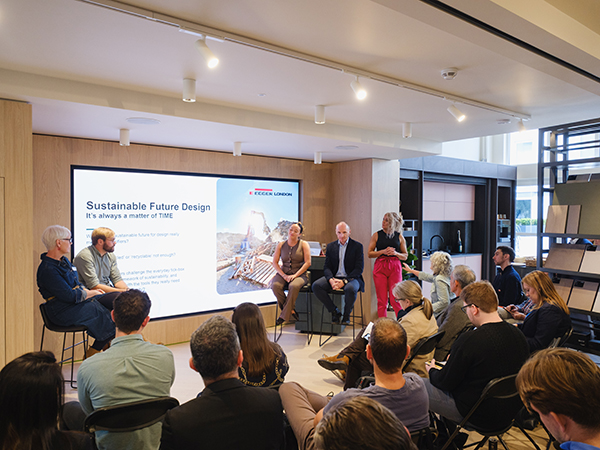
Speaking at Egger UK’s Clerkenwell showroom, representatives of both Blum and Egger said the time of sustainability being seen as a “nice to have” add-on is long behind us, and that there is now a strong expectation on retailers and brands to embrace sustainable values.
Discussing the topic of sustainability as part of London Design Festival, the panel included Anna Gibson, Egger UK’s decorative product manager; Max McLaughlan, Egger UK’s director of forestry and head of wood purchasing; Tom Nesfield, Egger UK’s environmental manager and energy manager; and Amanda Hughes, Blum UK’s interior design channel manager.
“We’re making products that are not only financially valuable, but also much better for the environment. And one of the best things our customers want to know about is that recycled content element,” Gibson explained.
“For them, it’s for the purpose of marketing, it makes their business look good that they really are buying into that recyclability. Sustainability is no longer a nice to have, it’s expected.
“I had the opportunity earlier to go to the design festival in Shoreditch, and I was totally blown away by these three 25-year-old designers. The products that they’re designing – sustainability is at the heart of everything. And even though their work has nothing to do with our industry, it just goes to show that the message is so important and so clear.”
When asked if she though retailers did enough to sell the sustaibable credentials of companies like Egger, Gibson replied: “No, but I think it depends on what company you’re looking at. You can see some large scale PLCs who are doing it, but it all depends on staff. It’s personality dependent, I think. Do they have good ESG? Do they have a strategy? Or are they just trying to tick a box?”
Blum’s Amanda Hughes agreed that retailers who aren’t prioritising sustainability will be left behind by the market, adding: “I think the furniture industry is very design led, and very aesthetic led. We tend to sell kitchens based on an aesthetic dream. And if retailers aren’t catching on to the idea that they need to be educated, they’re going to lose out, because the end-consumer is a lot more discerning.
“It’s all very well saying do you want a white kitchen, or a glossy kitchen, or contemporary kitchen, but the end consumer is now thinking, ‘what does this mean for me and my family?’. We’re selling it on aesthetic, then cost, and then on quality, but not thinking about longevity or functionality. It’s trying to get the industry to shift around and educate them so they can talk more about just the product from an aesthetic level, they can talk about it from an impact level – the impact to the planet, the impact to your life, the impact to your living situation.
“Don’t underestimate the consumer – they are the drivers, they will demand it, and any retailers not thinking about it will get left behind. No one wants ugly furniture, we all want beautiful looking kitchens, but we want to now scratch deeper, get behind the surface of it. We need to start having these debates and discussions.”
Egger opened its showroom on Clerkenwell’s Dallington Street last year, in collaboration with Cleaf and Blum. Although the space is led by Egger, it also combines the materials and products of all three brands together in an immersive display and working space.