

Are relationships between suppliers and retailers improving?
With retailers and suppliers set to gather at kbb Birmingham this week, much has been said in recent years about the deterioration of relationships between the two. But where are things actually breaking down, and what can they do to get along like happy families again?
With kbb Birmingham now just a matter of days away, it’s hard to believe two years have passed already since the last time the KBB industry descended en masse upon the well-trodden halls of the NEC.
And if you cast your mind back, aside from all the new products and time spent “networking” at the bar, there was one very thorny issue that seemed to prominently emerge from the last event: relationships between suppliers and retailers – or more specifically, how much have those relationships changed?
When polled by kbbreview in the run-up to kbb Birmingham 2024, many retailers said they’d grown frustrated at receiving fewer in-person visits from their sales reps, with many feeling like communication with suppliers had changed for the worse in recent years.
And when we took this info to kbb Birmingham two years ago, almost all suppliers agreed that the nature of communicating with retailers had, in fact, changed post-Covid. Most admitted that while virtual channels like emails or video calls were handy, they were essentially a pale imitation of face-to-face visits from sales reps, and more than a few announced that their customers would be enjoying more contact in the near future. But, with two years now in the rearview mirror, has the industry actually done anything to fix it?
Well, judging by the results of the recent kbbreview Retailer Survey from January, things do actually look to have improved – albeit only slightly.
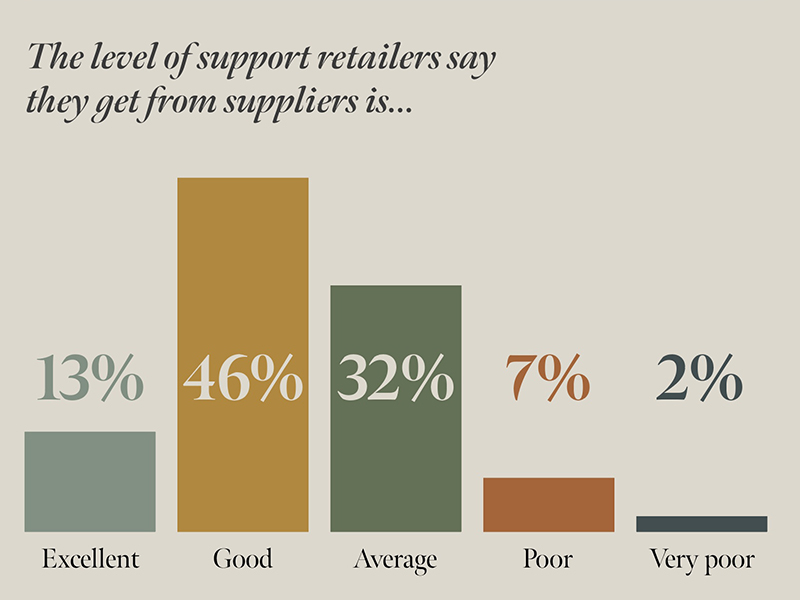
This year, 13% of retailers said the level of service they get from suppliers was “excellent”, which is up by a modest 4% over the last two years. And almost unchanged, 47% of retailers said that they received “good” service from the brands that they work with, up by 1% over 2024’s research.
However, while it’s good news that some retailers are reporting better levels of communication and service, it all goes downhill a bit from here.
Whereas 5% of retailers said they thought support from suppliers was “poor” in 2024, that number has now risen slightly to 7%. Similarly, although only 1% of retailers said they got “very poor” service from their suppliers in 2024, that number has now increased to 2% in 2026.
And for those wondering, 32% of retailers said the level of support and communication from their suppliers was “average”, which is down slightly from 2024’s 39% – although it’s almost impossible to tell if the 7% difference is down to retailers thinking service has improved or worsened.
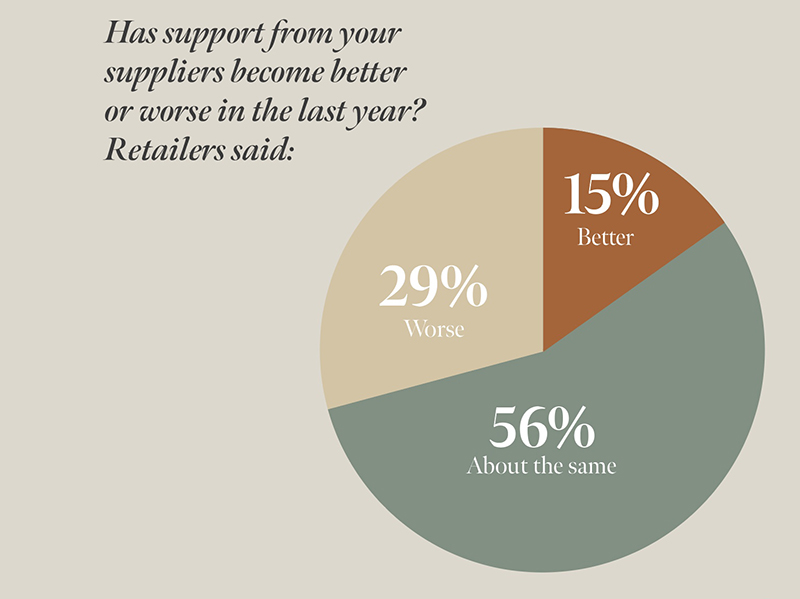
To dig a bit deeper, we also polled KBB retailers about whether they thought the level of support they got from suppliers had changed in the last 12 months.
Concerningly, three-in-ten (29%) think support has been worse since the start of 2025. Although 56% said they thought it was “about the same”, and an encouraging 15% thought it had actually improved.
And while these statistics are helpful for painting a broad picture of what’s going on, they don’t exactly get to the heart of why things might have become better or worse. So, under the promise of anonymity, we asked retailers on the front lines for their own conclusions about whether supplier support had improved drastically or taken a nose dive.
Vanishing visits
Firstly, it’s important to note that most retailers began their assessments by acknowledging that there are likely as many fantastic suppliers in the market right now as there are difficult ones. Or to put it more simply: the phrase “it’s a mixed bag” was mentioned more times than I’d like to count…
However, one thread running through a lot of their comments was how most suppliers have likely had to explore ways they could become more cost-effective in the last few years, and sadly, reps on the road seem to have become a considerably more endangered species, at least according to retailers.
“We’ve seen significant changes in supplier personnel over the past couple of years,” notes one. “Many new representatives are not staying in post for long, resulting in limited relationships and long-term understanding. Too often, we’re met with inflexibility.”
Another explained: “Being based in Cornwall, we naturally receive fewer visits, and there has been a noticeable turnover of reps in our area. That said, we are fortunate to work with some fantastic reps who provide excellent support. But there have been a couple of brands where we haven’t seen a rep since we opened, despite displaying them in our showroom…”
Meanwhile, several retailers suggested that its not suppliers themselves that are the problem, but the fact that the general calibre of sales representatives could have changed in recent years.
“The relationship between the supplier and the retailer is no longer what it used to be,” lamented one. “The sales representation in general across all our industries (we are also in the fireplace market) is very poor. Most reps are brochure droppers, can’t book an appointment, don’t know how to gain business or even a foot in the door sometimes.”
A different retailer agreed: “The quality of ASMs has become very poor. The old school who are disappearing fast would ring and make a regular appointment to visit and discuss if there is anything they can do to help. The new ASMs are spreadsheets and just turn up even if you have a client in the showroom. When they call, they don’t ask ‘why is your turnover down?’, they just say that if you don’t hit a target they will have to look at your terms!”
On the other hand, many retailers said they had good relationships with sales reps, but often struggle to get support from head office when things go wrong.
“Service levels in general are not good enough,” insisted one retailer. “It varies across the board – some are much worse – but there is very little acknowledgement of the end consumer. Not enough effort is put into rectifying problems when they arise. Far too often the retailer ends up with a bad review or out of pocket when things go wrong.”
Echoing this sentiment, another said: “We’re happy to sell the product, but we always end up at the sharp end where we have to take on the responsibility of defects and damaged goods.”
Standout suppliers
But at risk of focusing too much on the seemingly negative responses to this year’s kbbreview Retailer Survey, it’s worth pointing out that a huge chunk of our retailer readers had lots of praise to heap on their suppliers.
As one explained: “We have streamlined who we are working with and made some swaps to ensure better brand alignment down to what our customers are asking for. As we’ve grown with brands over the years, they have seen how proactive we are and how much business we put through them. The support all round has been great, whether it’s down to a quick response on a technical enquiry or down to displays.”
Similarly, another added: “I’ve had mostly the same suppliers for several years, some of them since I opened the showroom in 2003. I have good personal relationships with all of them. Any small issues are usually resolved quickly, I’m happy, and they get paid on time.”
In fact, in the wake of the much discussed changes to supplier/retailer relationships, several independents said that the situation had only made them more likely to align themselves with brands who genuinely support them.
“We are a small business, we’re probably not high up any supplier’s priority list. And we know that. So we focus on the ones whose customer care is good enough to go far enough down the list to get to us,” explained one retailer.
Again emphasising how support is a two-way street, another added: “We chose our suppliers not just because they offer a product we’re passionate about, but also because we believe we’ll receive value and support from them. We are advocates of each other’s work, and that goes a long way.”
Another added: “Some really look after us, but others really don’t care – and I’m starting to lose patience with the latter! It’s so competitive I don’t think suppliers can afford to be complacent in this day and age!”
And although this is all clearly a nuanced and complicated issue, one retailer had the incredible wit and wisdom to sum up the hundreds of retailer responses in less than a dozen words: “I wouldn’t work with suppliers who don’t care about my business.”
Perfect partnerships?
But as everyone knows, relationships are, of course, a two-way street, and it’s only fair that we also polled suppliers for their thoughts on retailers, as well as the way they do businesses with them. So in the interest of fair play, we asked more than a hundred KBB manufacturers: how many of the independent showrooms you supply would you personally recommend to family or friends?
It’s so competitive I don’t think suppliers can afford to be complacent in this day and age
Roughly one-in-five (21%) said they’d recommend 80-100% of the retailers they work with, and a healthy two-in-five (40%) said they’d recommend 60-80% of the showrooms they supply, which is still broadly encouraging.
A slightly more concerning 22% would only recommend between 30-60% of their showroom partners. And alarmingly, roughly one-in-five KBB suppliers (17%) said they would recommend less than 30% of their retailers.
Or, shifting the statistical lens slightly, that means roughly three-quarters of suppliers (74%) would happily recommend the majority of retailers they work with – but a startling one-in-four (26%) genuinely would not recommend most of their retail partners to family and friends.
Which begs the question: if they’re happy to do business with them, what do suppliers believe retailers are doing so wrong? Or, more specifically, to try and qualify their responses a bit more, we asked: if KBB retailers could only do one thing to improve their business, what should it be?
Naturally, perhaps the most common response was that retailers should branch out and diversify their offering a bit more.
“Differentiate, try something new, and don’t wait for things to change,” suggested one supplier employee. “Adapt with the times,” advised another, “Technology is running ahead of our industry. Wren’s investment into virtual showrooms is a sign of what can be done and where the future lies.”
Aside from that, a larger than expected number of suppliers said that the most important thing retailers could do was tidy up their own showrooms. One advised retailers to “look at their showroom with new eyes, every morning, as though you worked for a big company chain and the managing director was coming to visit today. What needs your attention? Fix it!”.
“I go to some showrooms and see countless ranges, door samples and worktop samples taking over the showroom, it is too much for the client,” explained another supplier. “The showroom displays should be impeccable and all the fluff hidden away. People buy with their eyes and many times, all they see is samples.”
And bizarrely, when asked for the single, most-important change that all retailers could do to improve their businesses, one supplier simply advised they should “make showrooms warmer”.
Quite a lot of suppliers also suggested retailers should stock fewer brands, to keep their offering simplified and less confusing for consumers. For example, one advised: “Stop trying to be all things to all people by carefully considering the brands that are really trying to help support your business. Far too many retailers are attempting to compete at all ends of the market, which can leave their own customers very confused and their supply partners frustrated.”
“Stay in control of your product offerings,” said another, adding: “Ditch having a large showroom as they are expensive and generally are boring as hell.”
Looking over all of the responses, ironically, while suppliers all seem to have opinions on what retailers should be doing or trying, they don’t seem to be able to agree between themselves on what those strategies should be. In many cases, what one supplier sees as a completely obvious path to growth is something another supplier wouldn’t advise touching with a barge pole.
For instance, for every supplier suggesting studios should reduce their brand offering, there’s a chorus more saying that retailers actually need to diversify and supply more styles, with one saying retailers should “realise that they can sell almost anything they like and they don’t need to be bolted to brands.”
No easy answers
So it seems that despite the big brands clearly having their own (in many cases, strongly held) opinions about what showrooms should be doing to improve the relations between supplier and retailer, just like the studios on the other side of the fence, there’s clearly not an obvious solution.
And to clear up any doubts that suppliers only have bad things to say about retailers, we did also insist on asking each one for the best thing about working with independent retailers.
I go to some showrooms and see countless ranges and samples taking over – it is too much for the client
Thankfully, virtually every supplier said they genuinely admired the passion that independents brought to the industry, especially smaller showrooms.
One enthused: “Independent retailers are passionate, creative and highly knowledgeable. Their designs bring our bathroom products to life and they inspire us to continue to work hard and deliver a brand they love… they are our heart and soul.”
“They’re agile, creative and not restricted by rigid corporate processes – so they can make decisions quickly, adapt to market trends, and champion new products with real enthusiasm,” said another. “When you partner with an independent, you’re working with people who value relationships, trust and long-term success just as much as you do.”
So, if we’ve learned anything, it’s that there does seem to be a general sense that the relationships between suppliers and retailers is on the mend (even if there are clearly still a few brands out there that could be doing a bit more for their retailers).
On the flipside, KBB suppliers also evidently have gripes with the way that some retailers operate, and given how many studios they have to deal with, there’s never going to be a one-size-fits-all communication model that works for every independent in this enormous and ever-changing industry.
But if there’s one thing we can say for certain, it’s that retailers are taking note of the brands that are supporting and communicating with them, and ultimately, they’re the ones making choices about the limited showroom space that serves as the one real link between KBB brands and consumers.
The real question is, are enough suppliers paying attention to that?
