

The low-down on low-silica
The debate around worktop fabrication and silicosis has led to a burst of product development and ground-breaking new technologies that focus on low silica materials. Is this the future of worktops for the industry?
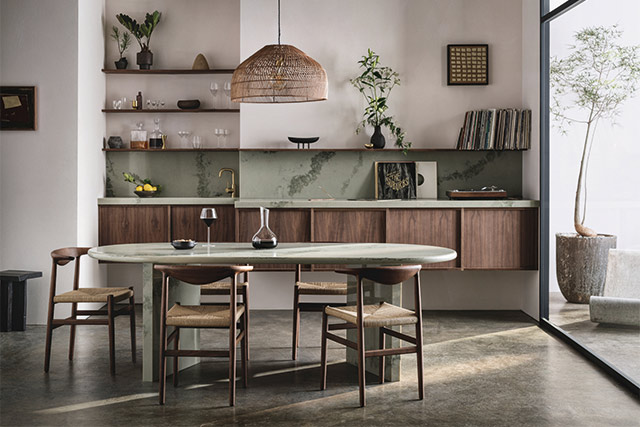
is the 8477 Ocean Sage.
Words: Francesca Seden
A year ago, in July, Australia implemented a ban of engineered stone worktops following rising numbers of stonemasons and fabricators presenting with the respiratory disease silicosis.
Since then, a number of alarming headlines have hit the news, warning of the “dark secret your worktop is hiding”. While, at best, sensationalist and, at worst, downright untrue, this focus has undoubtedly led to a wariness in some consumers.
However, there is also no question that this attention has led to a number of positive consequences. Firstly, there is a new focus on safety and best practice – always to be applauded – and secondly it has led to a rush of product development and investment as silica-free and low-silica alternatives are launched to the market.
But first, let’s look at the fundamentals – is engineered stone a threat to homeowners?
“In reality, crystalline silica is one of the most abundant minerals on Earth” explains Jonathan Stanley, VP of marketing and customer service at Caesarstone UK and ROI. “It is naturally present in sand, stone, and clay and, consequently, exists in a vast array of common building materials, including concrete, bricks, tiles, cement, and mortar.
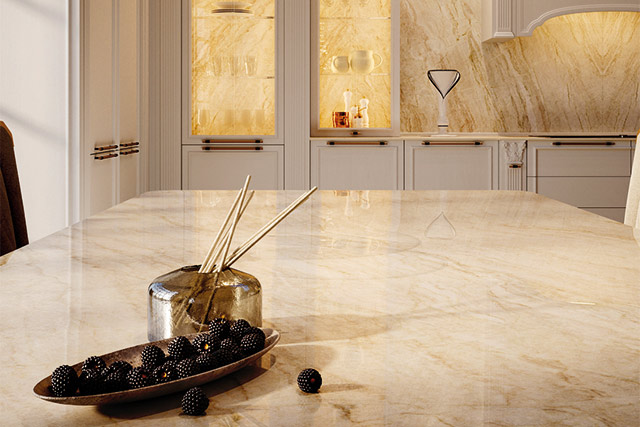
“The health risks associated with crystalline silica arise not from the material itself in its installed, solid form, but specifically from the inhalation of respirable crystalline silica dust during industrial fabrication or demolition processes, if proper safety measures are not diligently in place.”
It is crucial to understand that all of these materials can be processed if the necessary precautions are taken, and Caesarstone itself has stringent safety measures in place, as well as in-depth guidance available.
In fact, most of the leading brands share this view, each citing the same safety measures in place for dust suppression, including wet cutting to limit dust, full PPE including dust masks, and proper ventilation.
Despite this recognition within the industry that silica-containing product poses little risk if properly handled, there are many who agree that low silica options can allay consumer fears, and, perhaps, it’s a no-brainer to use them when technological advances mean these alternative solid surfaces can be just as good when it comes to quality.
However, it doesn’t deal with the fact that the problem is caused by ill-qualified fabricators who play fast and loose with health and safety guidelines and, often, choose the cheapest and lowest-quality materials.
“Without question,” Stanley insists, “the adoption of best-practice stone fabrication processes is the fundamental answer from an occupational health perspective.”
“Ban it!”

William Durrant, owner of luxury bespoke kitchen and cabinet makers, Herringbone House, is unequivocal in his assertion that high-silica products should be banned.
“We believe that with so many alternatives on the market it is simply not necessary to offer high-silica options at all. Simply don’t offer it. Our priority is to keep our staff, suppliers, and clients safe. Our stonemasons are confident that they have the strongest health and safety measures in place to protect their team and use water cutting to ensure this is safely done in their factory.
“However, for us, these risks are not necessary when there are alternatives on the market. We are the first company in the UK to ban the sale of high-silica quartz back in 2024, but we hope that more companies follow suit in the coming months.”
Looking ahead
So, what are the latest low- and no-silica alternatives on the market, what are their benefits, and what are consumers looking for?
High-performance, including durability, non-porousness and low maintenance all top the list, as well as great aesthetics, which often mimic natural materials. Sustainability is also increasingly a factor, and many brands now offer surfaces made from largely recycled material, which can also in turn be recycled at the end of its life.
Paul Gidley, UK Regional Director at Cosentino UK, says: “[Our] entire Silestone product line has low silica content – below 40% – and we are committed to ensuring all our new collections through the Silestone XM line have less than 10% silica. Our production process is also more sustainable – it uses 99% reused water and 100% renewable electric energy.”
Gavin Shaw, Laminam UK managing director, says that porcelain is leading innovation – not only for its durability and low maintenance, but also its ability to replicate natural materials with remarkable realism.
Meanwhile, Atlanta Bathrooms’ acrylic composites do not include granite, marble, or quartz. “Our surfaces are fully recyclable, affordable, and maintain a premium, high-end aesthetic,” Julian Pearson, commercial director says.
“They’re also non-porous, so they resist stains and are easy to clean, and can be safely fabricated on-site without releasing harmful dust,” he adds.
HIMACS by LX Hausys offers “upmarket cache”, according to UK country manager, Martin Saxby, and versatility – used as it can be “not only for worktops and splashbacks and integrated sinks.”
In spring 2024, Caesarstone introduced its initial low-silica surfaces, swiftly followed by the launch of its first crystalline silica-free surface, 5110 Alpine Mist, in October. “This year, we’ve taken an even more significant step with the introduction of crystalline silica-free surfaces under the Caesarstone ICON brand,” says Jonathan Stanley.
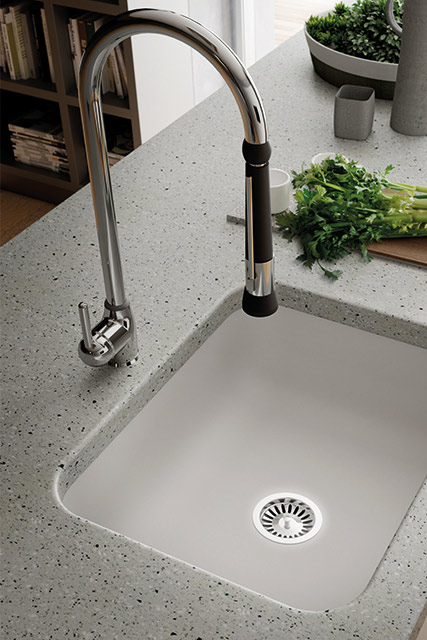
“ICON represents a new material category for us; it’s neither quartz nor porcelain, but rather an advanced fusion surface made from an innovative blend of materials featuring up to 80% recycled content.”
Hafele’s Minerva, Maia, Metis and Mariz ranges, meanwhile, are produced with two-thirds natural minerals and one-third high performance resin, made using powdered alumina trihydrate – a substance that has numerous benefits, including being flame retardant.
While these, and other, product developments are undoubtedly timely and innovative, the real question is whether they are likely to replace traditional silica-based materials completely.
Atlanta Bathrooms Pearson, says that, “as consumer awareness grows, so does demand for safer alternatives. Many customers are no longer willing to take risks with their health, no matter how small the risk may be. ”
Caesarstone’s Stanley adds: “It’s a fundamental change in mindset for the entire industry. Safer, more sustainable manufacturing and design choices should not be treated as a premium offering or a niche product. They must, unequivocally, become the new standard.”
At Roann operations and technical director Scott Wharton also believes that these new low-silica options will become more dominant in the market as regulations tighten and awareness grows.
“However, traditional quartz will likely continue to play a role, particularly where effective safety measures are in place and consumer demand remains strong. Rather than a total phase-out, we anticipate a more balanced market where low-silica options take the lead, and traditional materials coexist with stricter controls. For manufacturers, the focus must remain on offering safer, more sustainable choices across the board.”
Nigel Fletcher, operations officer, The Worktop Fabricators Federation

Are low silica alternatives the answer to consumer fears?
Low silica appears to remove a large percentage of the immediate risks to health but we don’t quite know if in years to come it could create a different set of issues. The real answer is the human respiratory system is not designed to consume large amounts of dust of any type, so the answer long term is in the removal of dust through suppression, filtration and extraction.
What steps should manufacturers and fabricators be taking to make working with silica safer? What steps have they taken?
All reputable slab manufacturers now appear to be moving towards lower silica products and producing stronger guidance on working with their materials. The stronger brands are introducing policies not to sell to fabricators who are known to be putting their employees at risk through dry fabrication.
This sends a very powerful message to the industry that this cannot continue and ignorance won’t be tolerated. The reputable fabricators are improving cleaning routines, educating employees, and monitoring dust levels periodically. Improvements to water recycling plants, tooling, PPE, extraction, suppression and filtration are at the forefront of the fabricators’ policies which are either in place or being implemented.
The stronger brands are introducing policies not to sell to fabricators who are known to be putting their employees at risk through dry fabrication
Nigel Fletcher, operations officer, The Worktop Fabricators FederationAre low-silica materials the future? Will we see a phasing out of all traditional quartz and other silica-containing material, over low/no silica options?
Low silica is definitely progress which will be a good step forward in the short term. Silica-free poses its own design and production limitations which may eventually be resolved given time and testing, the other issues are around the raw material demands, logistics and possible price volatility, along with increased demand of these silica free ingredients.
Is there a place for silica products to remain, given stringent safety measures and better PR?
Silica in its different forms is one of the largest naturally occurring minerals on Earth. You will come across it in every hour of every day in your daily life. Silica is not just a worktop issue.
If you compare the worktop industry to the petrochemical industry, the raw material is extracted from the earth, transported to factories (like refineries) where it undergoes processes that are extremely hazardous to the people operating around these premises.
It is then delivered and made ready and safe to use in a specific location (such as fuel stations). From there, the public can use the product freely and sensibly for its purpose with specific guidelines without any supervision or licensing.
The difference between the two industries are licences, training, regulation and inspections. If a scheme was established and correctly implemented into law, I believe it would prevent further deaths through not only [silicosis] but also lots of health and safety-related issues.