
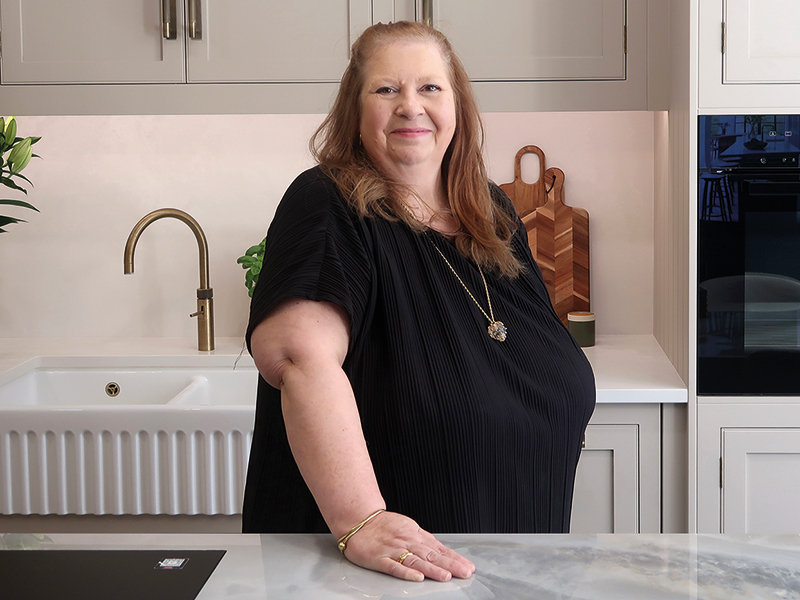
Interview: Susie Townsend, CEO, Harvey Jones
At 22 showrooms, Harvey Jones is still one of the biggest premium kitchen retail chains in the UK but there's no doubt it's been on a journey of ups, downs and multiple owners. But after a successful turnaround, new CEO Susie Townsend is focusing on growth and identity – "it was a fantastic brand built on fantastic heritage, but it was sleeping…"
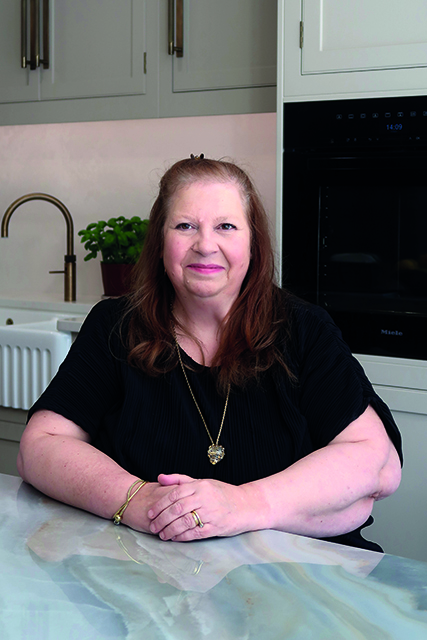
An ebullient Susie Townsend bounds across the showroom of Harvey Jones in Guildford as kbbreview approaches for a first-time-meet handshake. “I’m afraid I’m a hugger!” she declares and opens her arms wide.
A friendly squeeze later and it’s not hard to see how Townsend’s down-to-earth personality is already bringing a more grounded approach to a company that is still on the upward curve of a well-publicised buy-out and turnaround.
Founded in 1977 by Roy Griffiths, Harvey Jones began in a small garden workshop producing hand-built freestanding kitchen furniture. Growth followed to around ten showrooms until, in 2007, Griffiths left after a management buyout backed by private equity firm YFM Equity Partners.
This was followed by another buyout ten years – and another 20 showrooms – later, backed by Allied Irish Bank. Oh, and then another one in 2022 backed by Coniston Capital.
But this wasn’t enough to revive fortunes for what was then a struggling brand and, in February 2024, the company was rescued in a last-minute pre-pack deal by current owner RBC BlueBay Asset Management.
That was led by then-CEO and turnaround expert Vince Gunn, who had himself only been appointed just a year earlier. Gunn moved on last summer and Townsend, long-term collaborator and former commercial director, was moved into the CEO chair.
So, Harvey Jones has, without question, been through some dramas…
But Gunn and Townsend, backed by the new owner, have undoubtedly turned the company around. It has, for example, opened its largest ever showroom in Bicester Village at the end of 2024 and it is rolling out a new showroom concept that started with a flagship store in Chester in 2025.
The very showroom in Guildford we find ourselves hugging in now has also had that impressive makeover. But this isn’t about aesthetics alone, Townsend’s background is not kitchens but broader retail, and she is clearly bringing that expertise to Harvey Jones.
“When I came in, I looked at the showrooms through the eyes of a client,” she says. “I walked in thinking, ‘this is where I should fall in love,’ and too often that wasn’t happening…”
How do you see the overall health of the market at the moment?
I think it’s an interesting marketplace because of the breadth within it. You’ve got a real mix – nationals, value, premium, luxury, and then a huge independent sector, even down to virtual designers. In some ways it reminds me of the baby market I used to work in because of that diversity.
The challenge is how all of that works in synergy, because there are parts of this industry that feel very familiar from a retail perspective, and then there are other parts that are completely unique. In terms of the health of the market, I’d describe it as flat. There isn’t a huge sense of momentum or disruption. Some people have raised the lack of innovation and buzz, and I’d agree with that.
There aren’t enough disruptors pushing the category forward. At the same time, I do understand why, because economically it’s tough and there are a lot of businesses struggling. So it’s quite polarised – some are doing well, others are under real pressure, and a lot of it comes down to how proactive and disciplined they are.
What did you see when you first joined Harvey Jones?
I saw a fantastic brand built on fantastic heritage, but it was sleeping. That was my honest assessment. There was so much strength in the name and so much talent within the business, but it wasn’t fully alive in the way it should have been. It wasn’t a lack of capability.
The industry has talent, and Harvey Jones had talent. But it needed more energy, more innovation and, to be frank, more disruption. It also needed to look at some of the basics. Not just the front end, like the showrooms and how the brand presents itself, but also the infrastructure behind it. There are some wider industry challenges as well.
As a manufacturer, we’re dealing with labour shortages and a lack of apprentices coming through. That’s not unique to Harvey Jones, but it’s something the industry doesn’t always come together to address. And yet it’s fundamental if you’re thinking long term about growth and sustainability.
What have been the major strategic changes since the acquisition?
A big part of it has been modernising the showroom estate. That’s critical because clients still want that physical experience. They want to touch, feel and engage. They want to meet a designer. That’s what differentiates this category. But it’s not about rolling out a single template everywhere.
If you look at Chester, which was our first showroom in the programme, and then compare it to, say, Henley, you’ll see the Harvey Jones DNA, but you’ll also see evolution. That’s deliberate. The brand has to feel consistent, but it also has to move forward. At the same time, we’ve been stabilising the business while also growing it.
Those two things have happened concurrently. We’ve also worked closely with partners who understand our brand and client, but who can also help us innovate and leap forward. That balance is important, retaining the heritage while introducing newness, exclusivity and surprise.
What is the core idea behind the new showroom concept?
When I came in, I looked at the showrooms through the eyes of a client. I walked in thinking, “This is where I should fall in love.” And too often that wasn’t happening. It felt quite flat – in colour, in presentation, in inspiration. But consumers today expect excitement. So Chester became our starting point.
We took what we felt was the core Harvey Jones demographic and tested it in a showroom that matched that profile. Then we tested different formats – Bicester, which behaves very differently because of its location and shopping patterns, and Heals, which was a concession model.
Those three together gave us a really strong data set on how the brand performs in different environments. Chester did exactly what we hoped. It had the right location, the right client base, strong frontage and strong footfall. And our best conversions always come from showroom interactions, so that matters hugely.
What did you learn from those trials?
That retail disciplines really matter, even in a category like this. These are not traditional retail spaces in the purest sense, because the customer journey is longer and more consultative, but they are still retail environments.
One of the biggest changes we made was around space utilisation. Some showrooms had lost 40–45% of their space to desks, which meant customers couldn’t access it. That simply doesn’t make sense. So we redesigned layouts, improved navigation and made sure every part of the showroom was working hard.
We also looked at how we present product. It’s not just about cabinetry. It’s about helping clients make informed choices across the whole project, which in turn drives better outcomes and higher value.
In a busy premium market, where is the differentiation for Harvey Jones?
The obvious word people use is bespoke, but that means different things depending on who you ask. For us, it’s genuine. Yes, there’s a framework in the showroom, but our designers and craftsmen can work around the quirks of a home or a client’s vision. If someone has a beam, an awkward layout or a very specific taste, we can work with that.
Our designers can sit down with a client and create something that fits their dream, not just adapt a standard template. Not every client needs that flexibility, but the fact that we can offer it is important. And beyond that, the real differentiation is the experience.
Bespoke isn’t just about the product; it’s about whether a client feels the process has been tailored to them.
Surely your direct competitors would give a very similar answer?
I’m not sure they would, if I’m honest. I think you’d hear similar conversations around things like colour or worktops, because that’s fairly standard across the sector. But where I see the real difference is when a client brings something more complex to the table like a quirk in the space, or a very specific design idea.
If you went in and said, ‘you’ve got to get me around this, this is the quirk in my house,’ I think in some cases they would send you away or steer you back towards something more standard. Whereas our designers will sit down with you, work through it properly and find a way to deliver exactly what you want.
We’ve got the craftsmanship behind us to make that happen, and that’s where I think the real differentiation lies.
How do you approach sales skills in that environment?
It’s very different to traditional retail. The best designers can design and sell, but they don’t see themselves as salespeople in the conventional sense. They sell because they are good at what they do. We do train in sales, but it’s focused on rapport, understanding the client and managing the journey.
If you reach the end of the process and the client doesn’t convert, it usually means something has gone wrong earlier. So we focus on asking the right questions, listening properly and building trust. It’s still retail, but it’s a much more consultative and relationship-driven approach.
What are the key operational challenges beyond the showroom?
Installation and the full client journey are critical. We have some excellent installers, but we’re still on a journey to ensure consistency across the board. Not everyone is right for the brand, and that matters because the client experience doesn’t end in the showroom.
If the design and sales experience are strong but the installation isn’t, then you’ve failed. So we’re working to bring that part of the business up to the same standard. More broadly, there are industry challenges around skills and recruitment.
We need to bring through the next generation of craftsmen. That’s something I feel strongly about, and I think businesses like ours have a responsibility to support that.
Looking ahead, what does success look like in two years’ time?
We’ll have moved from stabilisation into profitability and growth. We’ll have a stronger infrastructure that supports that growth and allows us to scale in the right way. Our showroom estate will be more optimised. I don’t think we’ll be over 30, but it’s not about the number. It’s about having the right showrooms in the right locations, delivering the right experience.
And in terms of brand, we’ll be much clearer. When I joined, we talked premium but didn’t always deliver it consistently. Now that alignment is improving, and in two years it should be unmistakable. What gives me confidence is our people and our culture. Our best designers are being approached constantly, but they’re choosing to stay and develop with us.
That tells me we are on the right path. It’s a complex and challenging business, but it’s also exciting. And that balance is what drives everything forward.