
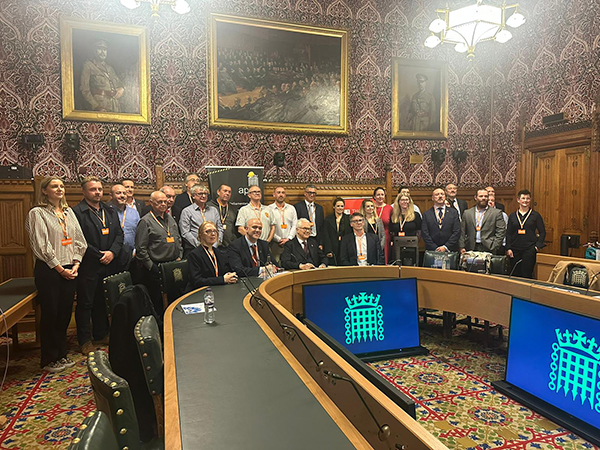
Experts including politicians, medical experts, trade unionists, and legal specialists have met at Westminster, calling for the government to take silicosis more seriously and urging for a UK-wide ban on high-silica stone products.
On Monday, November 3, a joint meeting of the All-Party Parliamentary Group (APPG) on Occupational Safety and Health at Westminster was chaired by Thompsons Solicitors, who brought together the group to advocate not only for a ban but also tougher enforcement of existing safety laws.
Silicosis is a serious lung condition that can be acquired by breathing in silica dust, which can be released when stone is cut into. There is no known cure for the condition, and those – such as worktop fabricators – that work with products featuring a high silica content can be highly susceptible if they do not follow health and safety precautions.
Australia made headlines back in 2023 when it implemented a national ban on engineered stone products, making it the first country in the world to do so. Since then, there have also been similar calls for product bans in other countries, including the UK.
However, many suppliers and industry trade bodies, such as the Worktop Fabricators Federation (WFF) have insisted that an Australian-style blanket ban on engineered stone products is unnecessary, and that the answer is instead tighter and more well-enforced health and safety regulations. In response to fears about engineered stone, several major surface brands have also introduced low- or no-silica surface products in recent years.
The UK has not banned engineered stone products, however employees do have a duty of care to limit stoneworkers’ exposure to respirable crystalline silica dust.
At this week’s APPG meeting, those in attendance heard testimony about the effects of silicosis on stonemasons who cut worktops. One of those in attendance was Dr Johanna Feary, an occupational lung disease consultant at the Royal Brompton Hospital, who was also the lead author on the UK’s first medical paper on the topic of artificial stone silicosis, published last year.
At this week’s meeting, Dr Feary told the APPG that since her paper was published, the number of confirmed silicosis cases in the UK has increased from eight to 45. As a result, Thompsons Solicitors partner Daniel Poet expressed concern that UK silicosis cases may be underreported, due to the delayed nature of the disease’s symptoms.
“This is a disease that can take years to show itself,” he said. “Like other industrial illnesses, we may not yet know the full extent of the damage that has already been done. In many of our cases, clients have been exposed to silica dust for only a few years, yet the damage is already severe. We’re also deeply concerned about the long-term impact on their ability to work and support their families as their conditions worsen.”
He also added: “Silicosis is a preventable disease, yet we are seeing younger and younger workers left with life-changing and often fatal health problems. The law is clear: employers have a duty to protect their workers. But too many are failing, and it is costing lives.”
Paul Nowak, the general secretary of the Trades Union Congress (TUC) also warned that the UK could see thousands more silicosis deaths without action. He continued: “The unsafe cutting of high silica stone must be banned – and backed by firm enforcement. Other countries are acting, and Britain must not be left behind. That can only be done with greater funding for the Health and Safety Executive, so it has the capacity to crack down on rogue employers who subject their staff to lethal hazards.”
Similarly, Jason Poulter from Unite the Union also attended in support of more action on engineered stone, saying: “We are proud to join the call for a ban on engineered stone and strict dust limits but we are also clear on the need for government legislation to extend the role and influence of union safety reps in defending workers across our industries.”
Representatives from Thompsons Solicitors say they will also meet next week with Sir Stephen Timms MP, who oversees the Health and Safety Executive (HSE), to ask him directly for further action on silicosis.