
Adopted Retailer February: Innova Care Concepts
Continuing our monthly Adopted Retailers series where we follow the journey of small KBB business owners, we check in with Innova Care Concepts – a business that sits between retail, design and healthcare.
Words: Matt Baker // Photography: Paul David Drabble
At its core, Innova Care Concepts focuses exclusively on complex care environments. Managing director Tom Hulbert describes the offer simply: “We focus solely on design, install and maintenance of specialist equipment and furniture into those care environments.”
And those spaces span health, education, social care and domestic settings, alongside a major works division that handles larger-scale adaptations. That focus is deliberate. Unlike general KBB retailers who encounter an accessible project less often, Innova’s entire team operates in this space full-time.
As sales and marketing director Bob Oliver puts it, the advantage for clients – and for professional partners – is that “everybody in this business is spending 100% of their time working in the healthcare sector.”
In practical terms, Innova’s work rarely begins with a casual showroom visit. Most clients arrive through referrals, typically from occupational therapists, case managers or other professionals supporting someone after a serious injury or life-changing diagnosis. These are often traumatic situations, involving not just the individual, but families, carers, legal teams and funders.
That complexity shapes how Innova approaches projects. Hulbert explains that one of the biggest challenges is not understanding needs, but communicating clearly with everyone involved. “You’ve got the client, family, occupational therapist, case manager, sometimes a solicitor – a whole load of people involved,” he says. “You’ve got to ensure that you’re communicating what you’re doing and why you’re doing it, so everybody’s comfortable.”
For designers used to a more straightforward client dynamic, this is an important distinction. Decisions are rarely just aesthetic or budget-led; they are tied to long-term care plans, future-proofing and, in some cases, ongoing litigation that can take years to resolve.
The business follows a four-stage process (Understand, Design, Execute, Protect) beginning with a deep assessment of the client’s current and future needs. Hulbert stresses that listening is the most important characteristic for designers working in this field. “You’re not just catering for the individual themselves, but also the family or carers,” he says. “It’s about listening to the needs of all users.”
That often means designing far beyond the immediate situation. Many of Innova’s clients are children who have acquired injuries early in life. Their parents are understandably focused on coping here and now, but the home must still work in 10 or 15 years’ time.
Designers are expected to anticipate how mobility, equipment and space requirements will evolve. As Hulbert notes, it’s easy to design for a five-year-old child, only to find the house no longer works when that child is a teenager using a much larger wheelchair.
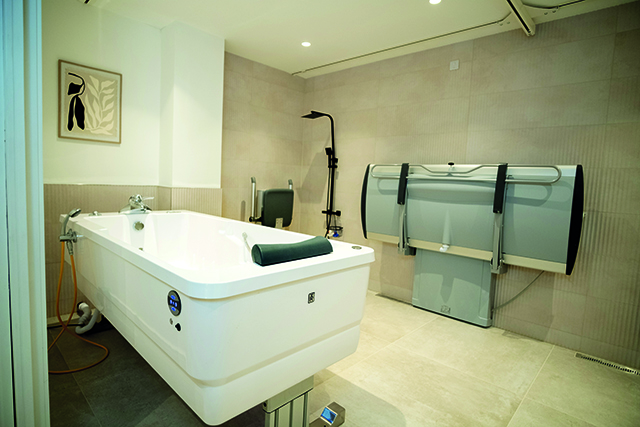
This future-facing approach is also central to Innova’s efforts to “design out” clinical aesthetics. From recessed ceiling tracks for hoists to joinery that conceals functional equipment, the aim is to create homes that feel domestic, not institutional.
Oliver points out that many clients have spent long periods in hospitals or rehabilitation centres. Their fear is that home will feel the same. Being able to show otherwise – physically, not just conceptually – has become a key differentiator.
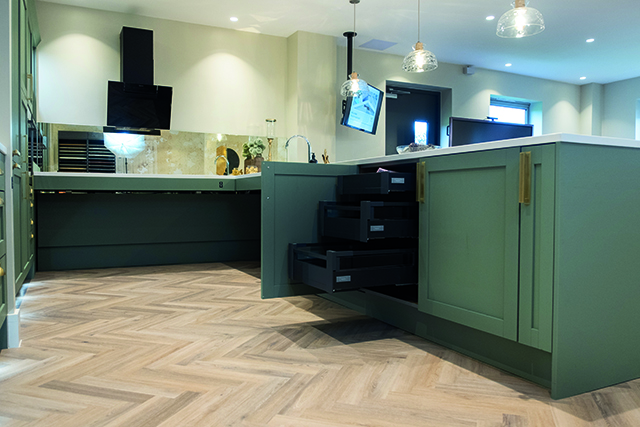
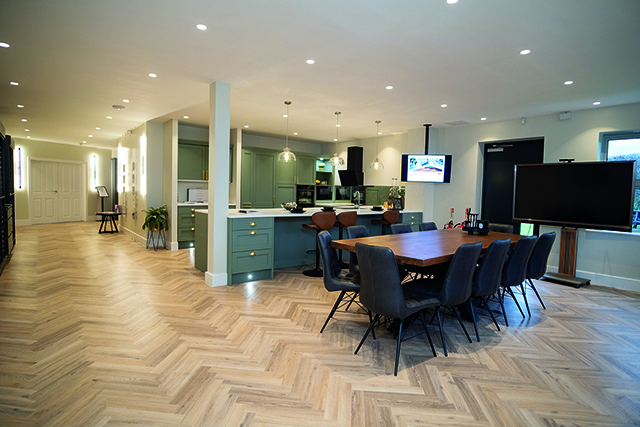
Accessible showroom
The refurbished Innova showroom is less about product display and more about experience. Early feedback from occupational therapists and clients highlighted a gap in the market: people could see specialist equipment, but not try it in a realistic setting.
Kitchens, in particular, became a catalyst for change. As Hulbert explains, “You can’t really just install a kitchen in a room that isn’t a kitchen. Clients want to understand how a complete environment works, not just individual features.”
Accessible kitchens have also emerged as a strategic growth area. Innova works exclusively with specialist solutions such as the Symphony’s Freedom range. Oliver believes this focus may lead to unexpected demand. “There’s no one else purely focusing on the adaptation side of kitchens,” he says, noting that many projects still involve a ‘standard’ kitchen with a few adjustments added late in the process.
Interestingly, kitchens often enter the conversation earlier than other specialist products. Parents may begin researching kitchens long before hoists or specialist bathing solutions, even if a wider adaptation project is years away from delivery.
In some cases, Innova sees kitchen enquiries two years before an order is placed, reflecting the long timelines associated with care funding and legal cases.
For independent retailers, this highlights both an opportunity and a risk. Without the right expertise, accessible kitchen projects can be underspecified or poorly integrated. Innova is open about its willingness to collaborate. Hulbert says the company is “absolutely prepared to work as a specialist retailer” alongside general KBB or interior retailers who encounter complex care requirements outside their comfort zone.
The business behind the service
Behind the scenes, Innova employs around 50 people, covering design, sales consultancy, project management, procurement, installation and servicing. The business operates its own warehouse to collate specialist equipment before installation, helping to streamline complex projects.
Importantly, it also employs its own service engineers, offering nationwide cover. Many products – hoists being a prime example – require regular checks by law. Long-term support is not optional; it’s fundamental.
Innova’s immediate plans include replicating its showroom model in other regions, with the South East a likely next step. Oliver admits there is some caution around the investment, but also curiosity about how much traction a new location could generate. Early data from the existing showroom suggests strong demand.
Innova Care Concepts offers a case study in specialisation. It shows what can happen when a business commits fully to a niche, builds deep expertise, and remains open to collaboration rather than competition.
As accessible and inclusive design becomes less of a niche and more of a mainstream consideration, those lessons are likely to resonate well beyond the complex care sector.