
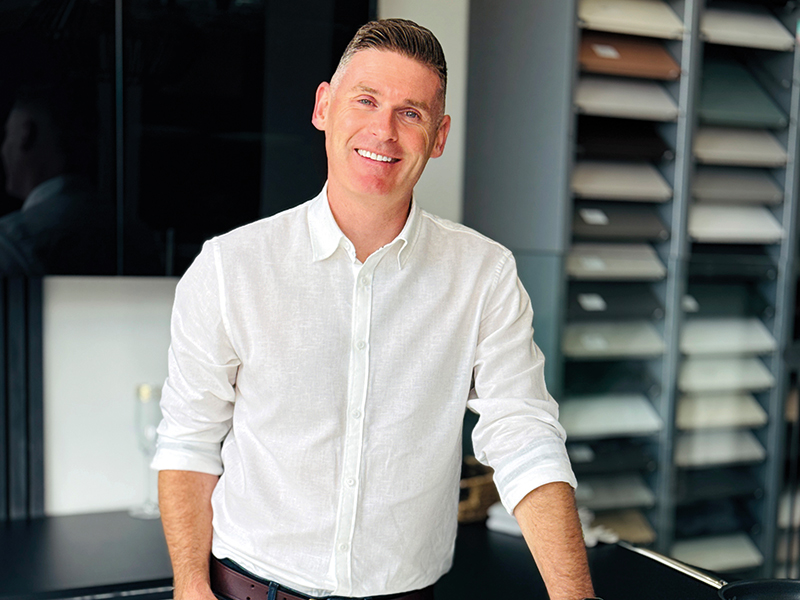
The kbbreview Interview: Luke Wedgbury, KBSA MD
Luke Wedgbury has big plans for the KBSA, from making membership harder to achieve to giving retailers more reasons to join. The new managing director explains why it’s time for change – and how he intends to make it happen from the inside out…
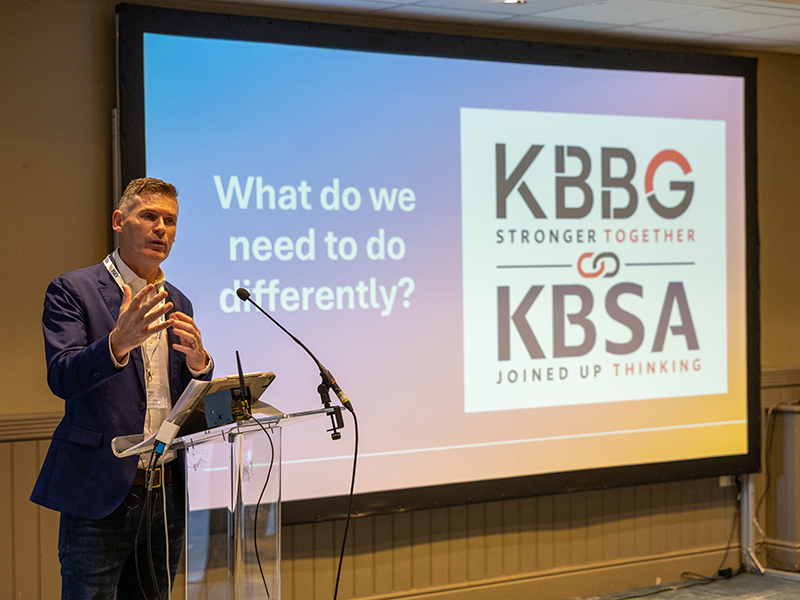
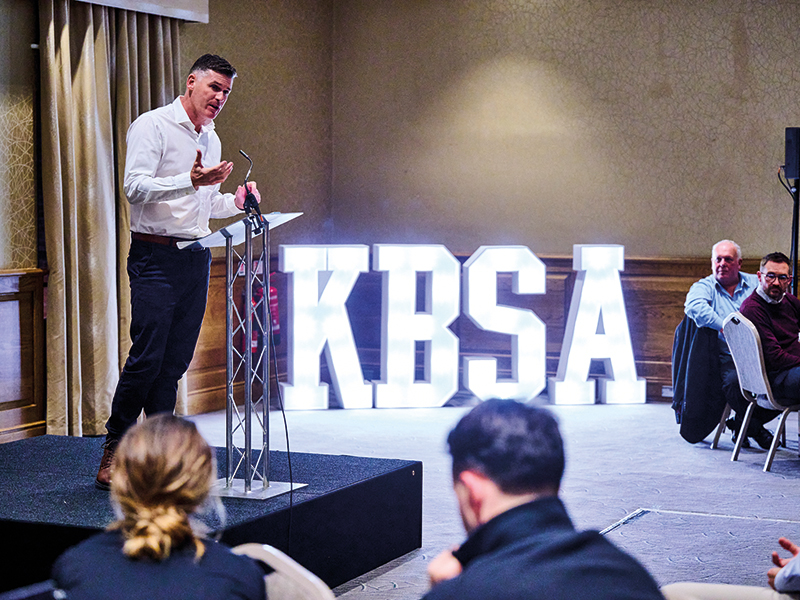
New KBSA managing director Luke Wedgbury is at the podium, speaking with vision and verve about the virtues of independent kitchen and bathroom retail.
His rhetoric, full of genuine ideas and ambitious goals, is nothing less than a manifesto for change in an organisation that’s fast approaching its 50th anniversary milestone.
It would not be too grandiose to describe it more like the Burnham-esque speech of a new leader rallying the party faithful at a political conference than the opening welcome to a regional networking event at a Midlands golf club.
But, as he says afterwards, it was his first speech in the newly-created managing director role and he wanted to make it count…
There’s something of a revolution taking place at the KBSA, an overhaul doggedly pursued by outgoing chairman Richard Hibbert has reached a point where Wedgbury can take over with a mandate for real change.
There are new initiatives, ambitious promises and, above all, a clear message that the association needs to become more relevant, influential and, yes, useful to the independent kitchen and bathroom retailers it represents.
Wedgbury had originally stepped up as vice-chairman earlier this year to support Hibbert, but when he subsequently left to become the new managing director of The Kitchen and Bathroom Buying Group (KBBG), Wedgbury resisted the assumption that he would automatically take over as chairman.
Instead, he argued that the KBSA needed a different structure. Hibbert, he believed, had been doing far more than the traditional chairman’s role, and the association needed somebody with direct responsibility for turning the board’s ideas into action.
The result was the creation of a managing director position, with Wedgbury taking on responsibility for the day-to-day running of the organisation.
As he puts it, he’s now “the guy who has to get stuff done”. And there’s certainly plenty to do if it is to realise any of the ambitions he sets out.
Wedgbury remains, first and foremost, a retailer himself. As the owner of Coalville Kitchens near Leicester, he understands the pressures facing showroom businesses, but his challenge now is to channel the optimism and ambition he brings to his own business into something tangible for the association.
“The KBSA has never been short of good ideas,” he says. “What it has sometimes lacked is the ability to make them happen…”

Let’s go back to basics. What is the KBSA actually for?
That’s a question we’ve been asking ourselves for probably a year because we as the board felt the fundamentals were getting a little lost. My ultimate ambition is that every independent retailer who’s part of the KBSA feels that we can wrap them in a blanket and say: “We’ve got you. You’re going to be OK.” That means giving them a genuine reason to be a member that is directly beneficial to their business. Whether that’s business development, education, deposit protection, compliance or simply having somebody to talk to and a sense of community. We want to create a culture that people want to be part of because it brings value to their everyday business and isn’t just a club you join because you get a badge on the door. The KBSA is here to support independent retailers, simple as that, and we want them to know that when something changes in the industry, we’re already looking at it and can explain what it means for their business.
How much of this change is being driven by difficult market conditions?
It’s hugely relevant because independent retailers organically need more support when things are difficult. If the market’s fantastic and everybody’s making lots of money, they might not see why they need an association. But that’s not where we are. Most independent retailers are working incredibly hard and, as an example, they’re struggling with staffing and recruitment. We talk about the installation skills shortage, but we haven’t even scratched the surface of the shortage of good designers. We’re constantly hearing from retailers who simply cannot find the right people so when the market is tough, the KBSA becomes much more relevant because businesses need that support and we’ve got some exciting developments coming.
Do you think independent retailers broadly need to change the way they approach running their businesses?
I think being vulnerable is a massive part of growth. You have to be prepared to admit that you don’t know everything and that sometimes you need help. Independent retail can be a very lonely place. Most of these people are entrepreneurs who’ve built their businesses from scratch, and they don’t necessarily have anybody they can talk to about the challenges they’re facing. Your friends and family see the trophies. They see the showroom, the nice car and the house. They don’t see the training ground, and that’s the really tough bit. That’s why bringing retailers together is so important. If you’ve got eight or 10 people around a table who are prepared to be completely open about their businesses, the knowledge and experience in that room is phenomenal. Whatever challenge you’re facing, there’s a good chance somebody else has already dealt with it and can tell you what worked for them. Sometimes just having somebody who understands what you’re going through can make an enormous difference.
You said in your first speech that the state of the market and the potential of an individual business aren’t necessarily aligned. What did you mean?
We hear constantly that the economy’s bad, consumers aren’t spending and everything’s difficult. That can create a subconscious feeling that there’s no point pushing harder because everybody’s in the same boat. But your business operates in a relatively small market. There are always opportunities, even in a downturn. I’m the managing director of the KBSA, but first and foremost I’m a retailer and my company, Coalville Kitchens, has had a very good year, but we’ve worked incredibly hard for it. We’ve looked closely at our sales process and margins and concentrated on explaining to customers why they should buy from us and why they should buy now. You cannot just sit back and think next year will be better. You have to keep evaluating your business and looking for improvements. I often say you can’t see the picture if you’re standing in the frame – sometimes you need to step outside your business and look at it differently.
Can the KBSA become a more powerful collective voice for independent retailers?
Absolutely, but we have to earn that position. Our membership is growing, but we need to offer benefits that make more retailers want to join. We also want our annual conference to become the must-attend event for the sector. We’re planning a new podcast too, which will give suppliers the opportunity to answer questions that retailers want to ask. There’s often a disconnect between retailers and manufacturers. When something goes wrong, suppliers can receive lots of criticism without necessarily having the opportunity to explain what happened or what they’re doing about it. We want to create that bridge and encourage constructive conversations rather than confrontation. That can only be good for both sides.
What role do suppliers have in your plans?
A very important one. Suppliers want access to good retailers and we can provide that. But we’re selective about our corporate members. They have to apply, the board considers them and sometimes we say no. Equally, we want our retailer members to be businesses that suppliers genuinely want to work with. Businesses that are properly run, vetted and committed to high standards. There’s a real appetite among suppliers to support independent retailers but sometimes that doesn’t get communicated particularly well, and I think the KBSA can help improve that relationship.
You also want to review the membership criteria. Could joining actually become harder?
Yes, absolutely. We want people to feel they’re part of something special and that membership means something. We’re reviewing the benefits we offer, how many members actually use them and whether they’re genuinely valuable but we’re also looking at the membership criteria. I think it probably will become harder to join because we want membership to represent a certain standard. When somebody tells a customer they’re a KBSA member, I want that customer to understand they’ve been vetted and audited and that membership carries real credibility. It shouldn’t just be a fee and a window sticker. I want retailers to be proud of it and actively talk about it to their customers.
The KBSA has traditionally been much stronger in kitchens than bathrooms. How will you address that?
We’ve got Koralia Hume from Quarrybank Boutique Bathrooms in Wilmslow on the board, who’s a very passionate and successful bathroom retailer, and she’s been a breath of fresh air. We’re also talking more to bathroom manufacturers and corporate members to make sure we’re relevant to that side of the industry. I am very conscious that I can’t just keep talking about kitchens, it has to be kitchens AND bathrooms. There are some interesting differences between the markets and, in some cases, bathroom retailers may have performed slightly better lately because the average project value is lower. But ultimately, we need to make sure both sectors feel equally represented.
Finally, where would you like the KBSA to be this time next year?
I’d like membership growth to be stronger and I’d expect our membership benefits to have been completely reviewed and reinvented, but the biggest thing for me is engagement. I want every member to see genuine value in belonging to the KBSA and, ideally, within the first minute of meeting a potential customer, I’d love them to be talking about their membership and why it matters. Ultimately, I want consumers to know who we are and what we stand for so we’re going to work tirelessly to make sure the KBSA is in a better place in 12 months’ time.
Listen to the full interview with Luke Wedgbury in a special episode of The kbbreview Podcast. Simply search ‘kbbreview’ wherever you get your podcasts.